


Abstract art with deep meaning: An art enthusiast's guide
TL;DR:
- Many people dismiss abstract art as lacking meaning, but it communicates emotion and spiritual intent through color and form. Its evolution from Romanticism to Conceptual abstraction demonstrates a deep tradition of conveying layered, non-material messages. Deep abstract works engage viewers through tension, texture, layering, and open interpretation, inviting ongoing reflection and emotional connection.
Most people walk past an abstract painting and assume there is nothing to “get.” No story, no subject, no message. That dismissal is one of the most common misconceptions in art history. Abstract art with deep meaning operates on a different frequency than representational work. It does not show you a landscape or a face. Instead, it transmits emotion, spiritual intent, and layered conceptual thought directly through color, form, and composition. This guide breaks down exactly how that transmission works and how you can read, evaluate, and collect abstract works with genuine depth.
Table of Contents
- The origins and evolution of abstract art with meaning
- How abstract art conveys deep meaning: forms, colors, and spiritual vibration
- Techniques that add depth: layering, texture, and the passage of time
- Distinguishing deep abstract art from decorative abstraction
- How to experience and interpret abstract art with deep meaning
- Why the quest for ‘correct’ meaning in abstract art limits its true depth
- Discover original abstract art with deep meaning at Eman’s Gallery
- Frequently asked questions
Key Takeaways
| Point | Details |
|---|---|
| Abstract art expresses spiritual ideas | Beyond imagery, abstract elements like color and form evoke deep emotions and spiritual vibrations. |
| Meaning emerges from engagement | Interpretation depends on personal experience, inviting ongoing reflection rather than fixed answers. |
| Techniques add conceptual depth | Layering and texture mirror temporal and emotional complexity within the artwork. |
| Distinguish decorative vs deep | Deep abstract art holds tension and inquiry, unlike decorative art which focuses on harmony and mood. |
| Trust intuition to interpret | Use a visual checklist and embrace ambiguity to experience abstract art meaningfully and confidently. |
The origins and evolution of abstract art with meaning
Abstract art did not arrive fully formed. It developed gradually as artists grew frustrated with the limitations of depicting the visible world and sought to express what lies beneath it.
Abstract art grew out of a shift away from representational art toward expression of imagination and the unconscious. That shift began in the 19th century with movements like Romanticism and Symbolism, which prioritized inner vision over accurate imitation of nature. By the early 20th century, artists were ready to abandon the subject entirely.
Here are the key stages in that evolution:
- Romanticism and Symbolism (1800s): Artists began prioritizing feeling and imagination over accurate depiction of nature, laying the philosophical groundwork.
- Expressionism (early 1900s): Color and distortion became tools for conveying emotion rather than describing reality.
- Wassily Kandinsky’s breakthrough (1910s): Kandinsky became one of the first artists to produce fully non-representational paintings, explicitly linking abstraction to spiritual expression and what he called “inner necessity.”
- Abstract Expressionism (1940s to 1950s): American artists like Mark Rothko and Franz Kline used scale, gesture, and raw paint to create art with profound significance, engaging the viewer’s entire body, not just their eyes.
- Conceptual abstraction (1960s onward): Meaning moved further inward, with artists using process, material, and system as the primary subjects of the work.
Each stage pushed deeper into non-material meaning. Understanding this arc helps you recognize that meaningful abstract art is not arbitrary. It is the result of a long, serious tradition of artists asking what art can communicate beyond the visible. Explore how this history connects to modern abstract art trends shaping today’s collections.
How abstract art conveys deep meaning: forms, colors, and spiritual vibration
Once you understand where abstract art came from, the next question is: how does it actually work? How do shapes and colors carry meaning?
Kandinsky, one of the most articulate theorists of abstract art, argued that colors and shapes evoke spiritual vibrations the way music does, guiding viewers into non-material realms. That is not mysticism for its own sake. It reflects a real perceptual phenomenon: color affects mood, form suggests movement or stasis, and composition creates psychological pressure or release.
Key expressive tools in abstract painting with deep meaning include:
- Color temperature: Warm colors (reds, oranges) generate urgency and intimacy. Cool colors (blues, greens) create distance, calm, or melancholy. The tension between warm and cool within one canvas creates psychological complexity.
- Shape and edge quality: Hard geometric edges feel rational and controlled. Soft, organic forms feel intuitive and bodily. An artist who mixes both within the same painting creates a conversation between order and chaos.
- Compositional weight: Where the artist places mass on the canvas determines where the viewer’s eye travels and where it rests. An unresolved tension, where visual weight never fully settles, keeps the viewer engaged and thinking.
- Visual rhythm: Like music, abstract painting uses repeating elements (marks, colors, intervals) to create rhythm. Rhythm in composition sustains viewer engagement through tension between control and release.
“Colors and abstract shapes evoke spiritual vibrations like music, with abstraction leading viewers into non-material realms.” — Wassily Kandinsky, Concerning the Spiritual in Art
The role of texture in this equation is equally significant. A rough, heavily worked surface invites touch, slows the viewer down, and adds a physical dimension that flat reproductions cannot replicate.
Techniques that add depth: layering, texture, and the passage of time
Understanding expressive tools is one thing. Knowing how artists build those tools into a finished work is another. The most conceptually rich abstract paintings are rarely made quickly.
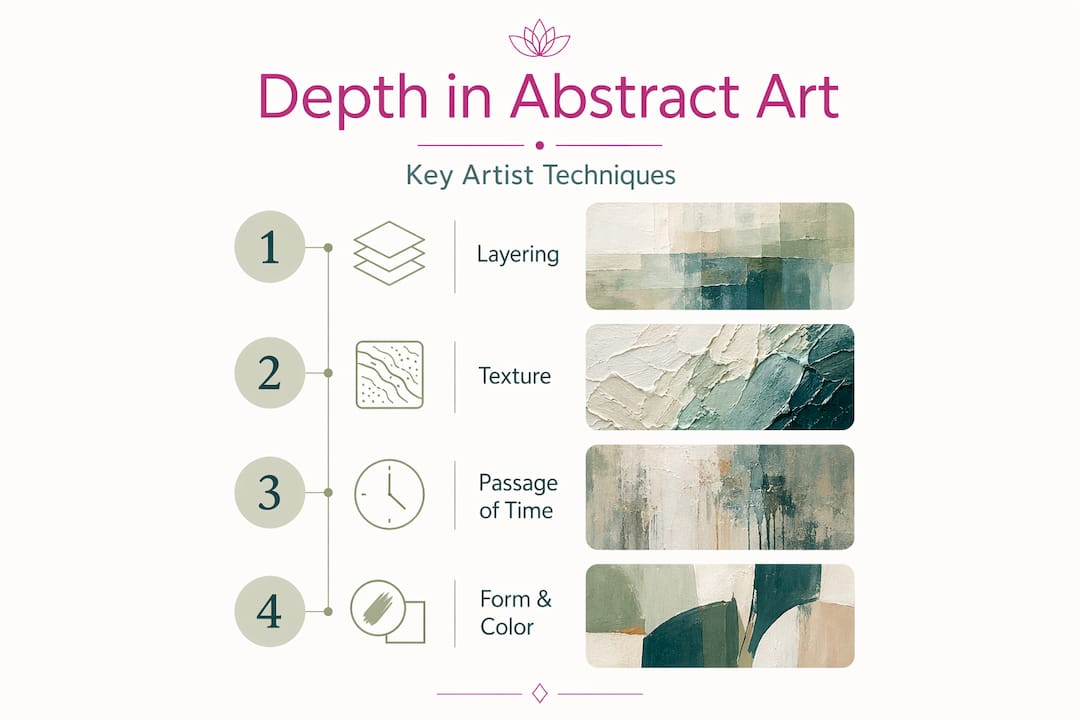
Jiang Miao’s paintings use dozens of pigment layers and irreversible incisions to capture time and create tunnels inward, inviting deep reflection. That process of building and then cutting back, revealing older layers beneath new ones, transforms the painting surface into a record of time. You are not looking at a final image. You are looking at a history.
Techniques that create this kind of depth include:
- Layering: Applying multiple transparent or opaque layers of paint builds physical depth and creates color interactions that cannot be planned precisely, only discovered. Each layer represents a decision, and the accumulated decisions become visible as complexity.
- Incision and scraping: Removing material reveals what lies beneath, a direct visual metaphor for memory, excavation, and the passage of time.
- Impasto: Thick, textured paint application creates surface relief that casts shadows and changes appearance under different lighting, making the painting a living object rather than a fixed image.
- Mixed media integration: Incorporating materials beyond paint, such as sand, fabric, or paper, adds material meaning. Sand evokes the earth; aged paper carries cultural memory.
Pro Tip: When viewing a heavily layered abstract painting in person, change your viewing angle. Move left, right, and crouch slightly. Texture-based depth only reveals itself through movement, and the experience is completely different from any photograph.
| Technique | Effect on meaning | Viewer experience |
|---|---|---|
| Layering | Suggests temporal and emotional complexity | Rewards slow, repeated viewing |
| Incision/scraping | Reveals hidden pasts; evokes memory | Creates visual surprise and intimacy |
| Impasto | Adds physical weight and materiality | Changes with light conditions |
| Mixed media | Introduces cultural or natural references | Grounds abstraction in real-world materials |
These techniques are not decorative choices. They are conceptual decisions that add meaning to abstract art, turning each painting into a layered narrative. See how these methods appear in elemental abstract compositions that use material and process as primary subject matter.
Distinguishing deep abstract art from decorative abstraction
Not all abstract art carries the same conceptual weight. This is a distinction many new collectors miss, and it matters when you are building a collection with purpose.
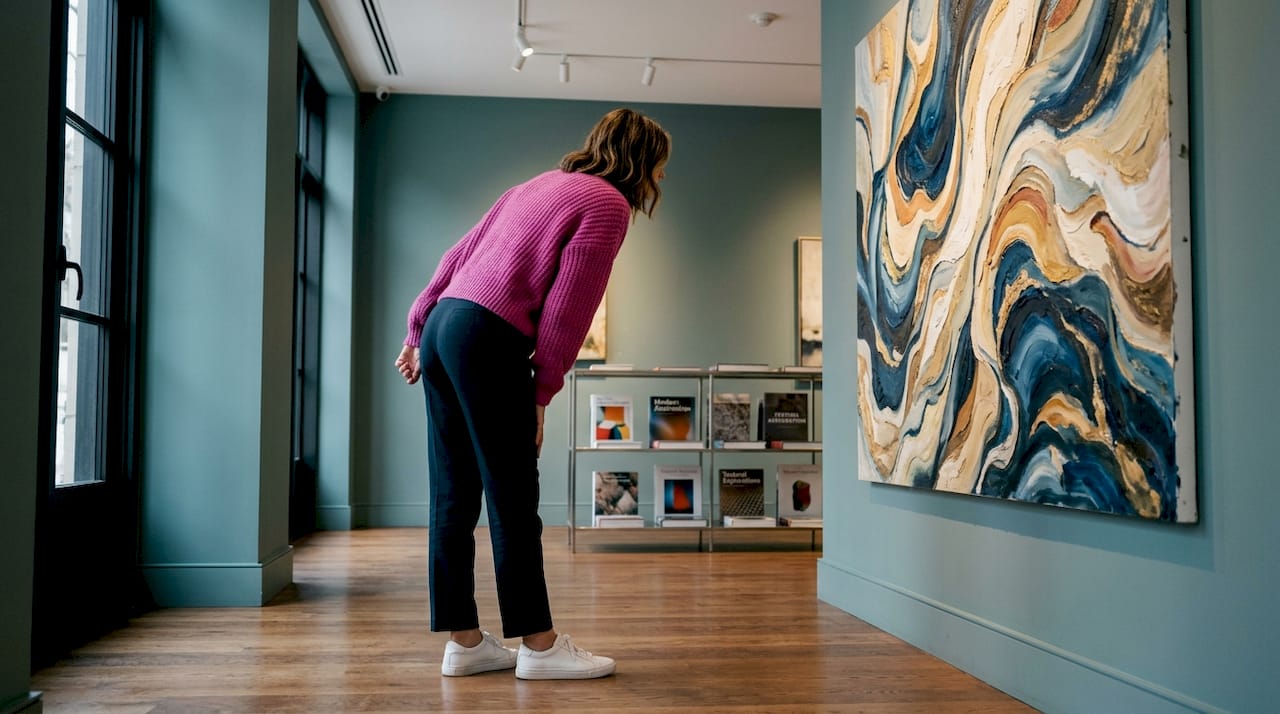
Decorative abstraction prioritizes harmony and visual pleasure over sustained inquiry and tension. That is not a criticism. Decorative abstract art has a clear and legitimate function: it enhances a room, creates a mood, and provides visual comfort. But it is a different category from symbolic abstract paintings designed to hold sustained attention and provoke thought.
Here is how to distinguish them:
| Characteristic | Deep meaningful abstract art | Decorative abstraction |
|---|---|---|
| Tension | Sustained and unresolved | Quickly resolved |
| Color complexity | Multiple competing relationships | Harmonized palette |
| Compositional intent | Invites prolonged inquiry | Provides immediate satisfaction |
| Conceptual framework | Artist’s process or philosophy visible | Aesthetic preference drives decisions |
| Viewer experience | Evolves over time and multiple viewings | Consistent and stable |
When evaluating a work, ask yourself these questions:
- Does the composition feel resolved, or does something remain unfinished?
- Do the colors create tension, or do they simply coordinate?
- Can you look at this for five minutes and still notice new things?
- Does the artist’s biography or process add a layer of meaning to what you see?
Pro Tip: A useful test is to revisit a painting’s photograph a week after you first saw it. If you remember specific details and find yourself curious about it, that is a sign of genuine depth. If you remember only “blue and gold” or “geometric shapes,” it was likely decorative.
For collectors looking to find original paintings that balance visual appeal with conceptual depth, this distinction is the most valuable evaluative tool available. It is also worth understanding how meaningful layering functions across different art forms.
How to experience and interpret abstract art with deep meaning
Here is where many art enthusiasts get stuck. They know there is something to experience, but they do not know how to enter the painting. The good news: there is no single correct way.
Viewers project personal meanings in pure abstraction, making engagement fully interpretive and subjective. That is a feature, not a flaw. The painting does not have one answer waiting to be unlocked. Your response is part of the work’s meaning.
A practical six-step approach to abstract art interpretation:
- Pause before analyzing. Stand in front of the work for at least 60 seconds without forming judgments. Let your eyes move naturally.
- Note your first emotional response. What does it feel like, not look like? Anxious? Calm? Curious? That response is data.
- Examine the composition. Where does your eye enter the painting? Where does it travel? Where does it want to rest and cannot?
- Study the color relationships. Which colors dominate? Which create friction? Does the palette feel deliberate or accidental?
- Consider rhythm and balance. Are marks repeated in a pattern? Does one side feel heavier than the other? How does that imbalance affect you?
- Allow meaning to stay open. Trust your intuition and co-create meaning without forcing a single decoding.
Pro Tip: Write a single sentence about what a painting evokes immediately after viewing it. Return to that sentence a month later. Most collectors find their interpretation has shifted, deepened, or expanded. That evolution is exactly how meaningful abstract art works.
The most rewarding abstract art viewing experiences treat the painting as a conversation partner rather than a puzzle. You are not solving it. You are engaging it. Explore this approach further in the context of interpreting abstract compositions built on elemental visual language.
Why the quest for ‘correct’ meaning in abstract art limits its true depth
Here is an opinion that most art guides will not state plainly: the desire to decode abstract art is actually the thing standing between you and the real experience of it.
Collectors and enthusiasts regularly approach a painting the way they approach a word problem. They want an answer. They want to know what it “means.” And when they cannot find a fixed answer, they conclude the work is empty. That is exactly backwards.
Abstract art’s meaning is not fixed. Viewer response co-creates meaning, and that process is essential rather than a failure. The painting is not withholding something. It is offering an open structure into which you bring your own emotional and intellectual content.
The most significant abstract works, Rothko’s color fields, Agnes Martin’s ruled lines, Lee Kufoni’s layered surfaces, become richer the more you live with them. Not because you eventually “figure them out,” but because you change, and the painting reflects that change back at you.
This has a practical implication for collectors. A painting that resolves itself on first viewing will not hold your attention in two years. A work that sustains ambiguity and complexity will grow alongside you. That is the distinction between art you buy and art you live with.
The real value of abstract art in a contemporary collection is not decorative or even financial. It is relational. The work asks something of you every time you stand in front of it, and that ongoing demand is where its depth actually lives.
Discover original abstract art with deep meaning at Eman’s Gallery
Eman’s Gallery offers original abstract paintings by artist Eman Khalifa, each handmade and built with the kind of layered intention this guide describes.
Works like the Good Tidings original painting and the Nocturned original painting are one-of-a-kind pieces that carry emotional and compositional depth designed to grow with the viewer over time. For collectors who want accessible options, the wall art prints collection brings the same visual language into museum-quality reproductions. Shipping is available worldwide from the UK, USA, Canada, Australia, UAE, and across Europe. Every piece is selected to offer something beyond decoration: a sustained visual experience with genuine conceptual weight.
Frequently asked questions
What makes abstract art have deep meaning?
Abstract art’s deep meaning comes from its use of color, form, and composition to evoke emotions and spiritual states that go beyond literal representation. As Kandinsky documented, colors and shapes evoke spiritual vibrations like music, guiding viewers into non-material realms.
How can I tell if an abstract painting is decorative or deeply meaningful?
Deeply meaningful abstract art sustains visual tension and invites prolonged engagement across multiple viewings, while decorative abstraction resolves quickly and prioritizes immediate harmony. Decorative abstraction focuses on harmony and visual pleasure over sustained conceptual inquiry.
How should I interpret abstract art I don’t understand?
Use a six-step visual approach covering composition, color, rhythm, and balance, and allow your interpretation to remain open rather than fixed. A six-step visual checklist helps viewers trust intuition and co-create meaning without forcing a single decoding.
What techniques do artists use to add depth in abstract art?
Artists build conceptual depth through layering pigments, creating surface texture, and using incision techniques that expose earlier layers of paint. Jiang Miao’s layered paintings use dozens of pigment layers and irreversible incisions to capture the passage of time and invite deep reflection.
Recommended
- What is urban art? Complete guide for collectors
- Explore major modern art styles: Complete guide for collectors
- The Essential Guide to Art Appreciation - Eman’s Gallery
- 7 Essential Modern Abstract Art Trends for Collectors - Eman’s Gallery
Stay Connected
- ✨ Explore Eman Khalifa’s original art
- 📸 Follow Eman Khalifa’s art journey on: Instagram @emans_gallery and Facebook Eman’s Gallery
- 📹 Watch Eman Khalifa creating live art on: YouTube @emans_gallery
