


Abstractionism Art with Meaning: What You Need to Know
TL;DR:
- Abstractionism art with meaning uses form, color, and gesture to evoke emotion and symbolic depth.
- It communicates complex ideas through physical decisions, compositional patterns, and emotional responses.
Abstractionism art with meaning is defined as visual work that communicates emotion, structure, and symbolic depth through form, color, and gesture rather than recognizable imagery. This is not accidental ambiguity. Artists like Jackson Pollock, Willem de Kooning, and Mark Rothko built entire careers on the premise that a painting could carry profound meaning without depicting a single identifiable object. The movement they shaped, Abstract Expressionism, became the first American art movement to achieve international authority. Understanding how that meaning works, and how to access it, changes how you see every abstract work you encounter.
What is abstractionism art with meaning?
Abstractionism, in its formal sense, refers to art that departs from literal representation to express ideas, emotions, or experiences through non-figurative visual language. The phrase “abstractionism art with meaning” captures what serious practitioners and critics have always argued: that the absence of recognizable subjects does not equal the absence of content. Meaning simply moves to a different address.

The act of painting itself becomes the content. Harold Rosenberg described the canvas in 1952 as “an arena in which to act” rather than a surface for representation. Pollock’s Autumn Rhythm (Number 30), measuring 2.7 by 5.3 meters, is the clearest proof of this idea. The scale and physicality of the work are not decorative choices. They are the meaning.
This distinction matters for anyone approaching abstract art interpretation. You are not looking for a hidden picture. You are reading a record of decisions, energy, and intention. That shift in expectation is the foundation of everything else in this article.
How does abstractionism convey meaning beyond visible forms?
Abstract works communicate through mechanisms that operate below conscious recognition. Once you know what those mechanisms are, you stop feeling lost in front of a canvas and start reading it.
The primary carriers of meaning in gestural abstraction are physical. De Kooning’s full arm sweeps and Pollock’s drip technique are not stylistic quirks. They are performative events where psychological decisions and bodily movement become the artwork’s content. De Kooning compared his approach to Miles Davis bending notes, treating painting as improvisation with the same structural logic as jazz music. That analogy is precise, not poetic.
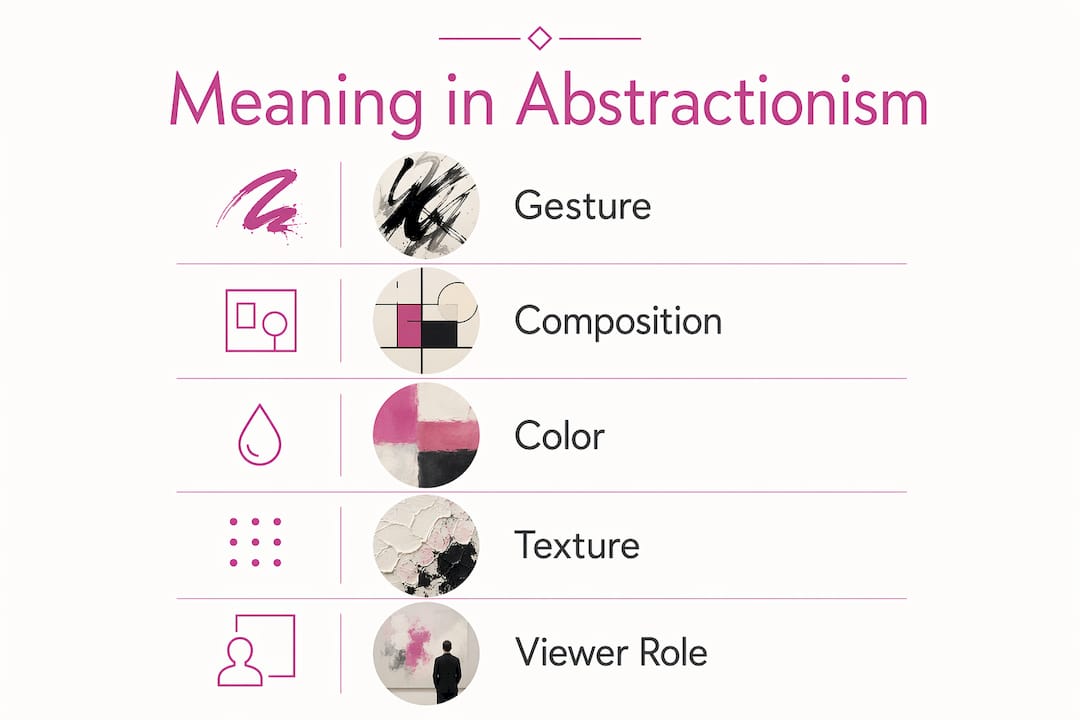
Composition adds a second layer. A 2026 study found that eminent abstract artists follow a measurable pattern of balancing visual “holes” and textures across the canvas, a principle researchers linked to the mathematical concept of Alexander duality. This means the apparent randomness in great abstract works is not random at all. Your eye already senses this structural rhythm, which is why some paintings hold attention and others do not.
Color and texture operate as direct emotional conveyors. Rothko’s large color fields do not represent sadness or transcendence. They produce those states in the viewer. Texture, whether thick impasto or thin washes, signals urgency, restraint, or deliberation without a single word.
Key mechanisms to recognize in any abstract work:
- Gesture and mark weight: Heavy, fast marks signal urgency; thin, controlled lines suggest precision or anxiety
- Compositional balance: Where the eye rests and where it moves reveals the work’s internal logic
- Color temperature and contrast: Warm against cool creates tension; analogous palettes create cohesion
- Scale: Large-scale works demand physical presence and change how the body responds to the image
- Texture and surface: The physical history of the painting is visible in its layers
Pro Tip: Stand closer to an abstract painting than feels comfortable. The texture, brushwork, and layering visible at close range carry as much information as the overall composition.
What are common interpretations and meanings attributed to abstractionism artworks?
Abstract art does not have one correct reading. It has a structured range of possible readings, and understanding that range is how you develop real fluency with the form.
The most common interpretive frameworks fall into four categories:
- Emotional and psychological: The work externalizes an internal state. Pollock’s paintings are frequently read as records of anxiety, freedom, or compulsion. The viewer’s emotional response is treated as valid data about the work’s content.
- Spiritual and transcendent: Rothko explicitly wanted his color field paintings to create a chapel-like experience. His Rothko Chapel in Houston was designed as a space for meditation across religious traditions. The paintings function as environments, not objects.
- Political and cultural: Abstraction has served as a form of resistance. Abstraction as subversion allows artists to communicate complex experiences, including trauma, identity, and marginalization, without producing imagery that can be easily co-opted or censored.
- Philosophical: Some abstract works engage directly with questions about perception, reality, and representation. The work asks what a painting can be, not what it depicts.
“Abstract art can function as presence without exposure, using ambiguity as a form of protection or subversion.” This framing, drawn from contemporary critical writing, explains why abstraction has been particularly significant for artists working outside dominant cultural narratives.
The viewer’s role in abstractionism is not passive. Your personal associations, memories, and physical responses are part of the work’s meaning. This is not a license to project anything onto a canvas. It is an invitation to bring your full attention and let the work respond.
How does the history of Abstract Expressionism shape its meaning?
Abstract Expressionism emerged in New York in the late 1940s and 1950s, shaped directly by the cultural trauma of World War II and the displacement of European artists to the United States. The movement split into two distinct approaches, and understanding that split clarifies how different abstract works carry meaning differently.
| Approach | Key Artists | Primary Mechanism of Meaning |
|---|---|---|
| Action Painting | Pollock, de Kooning | Gesture, physicality, process |
| Color Field Painting | Rothko, Barnett Newman | Color, scale, contemplative presence |
Action Painting, named by critic Harold Rosenberg, treats the canvas as a record of the artist’s physical and psychological engagement. De Kooning’s Woman I took over two years and 30+ repaintings. The tension between figuration and abstraction, the making and unmaking of the image, is itself the artwork’s subject.
Color Field Painting operates differently. Barnett Newman’s Onement I features a single vertical stripe dividing a field of color. Newman spent 18 months reflecting on the painting before he understood what he had made. The stripe is not a symbol. It is an event. The color field around it is not background. It is the experience.
Critic Clement Greenberg championed the formal qualities of Color Field work, arguing that painting’s meaning resided in its flatness and color relationships. Rosenberg argued the opposite: that meaning lived in the act of creation. Both were right about different artists. That critical disagreement shaped how abstract art has been written about, sold, and collected ever since.
Pro Tip: When reading about an abstract work, check whether the critic is aligned with Greenberg’s formalism or Rosenberg’s process-based view. It changes everything about how they describe the work’s meaning.
How can you engage with abstractionism to find personal and cultural meaning?
Engaging with abstract art is a skill, and like any skill, it develops with deliberate practice. The goal is not to decode a hidden message. The goal is to develop a more precise vocabulary for what you are already experiencing.
For viewers approaching abstract works:
- Start with your physical response. Does the work make you feel expansive or compressed? Energized or still? That response is information, not noise.
- Follow the eye’s movement. Where does your gaze go first? Where does it return? The structural rhythm of a well-made abstract work guides attention in ways you can trace.
- Read color relationships, not individual colors. A red in isolation means one thing. The same red against black means something entirely different.
- Look at the edges. How a painting handles its borders reveals compositional decisions that affect the entire work.
- Sit with ambiguity. Abstraction invites engagement with intuitive, personal dimensions of experience that resist quick resolution. Resisting the urge to conclude is part of the practice.
For artists creating abstract work, emotional authenticity is the primary technical requirement. Intuitive mark-making, where the hand responds to the work rather than executing a predetermined plan, produces the kind of expressive abstractionism that carries genuine content. The work knows when you are performing versus when you are present.
In 2026, the relevance of this practice has sharpened. As AI-generated imagery floods visual culture, human-made abstract works carry a quality that algorithms cannot replicate: the record of a specific body making specific decisions in real time. That irreducibility is not a nostalgic argument. It is a structural fact about what abstract painting is.
Key takeaways
Meaningful abstractionism communicates through gesture, structure, color, and process, not subject matter, and requires active engagement from both artist and viewer.
| Point | Details |
|---|---|
| Gesture carries content | Physical marks in Action Painting record psychological and bodily decisions that constitute the work’s meaning. |
| Structure is not random | Eminent abstract artists follow measurable compositional patterns that guide the viewer’s eye and create visual coherence. |
| Interpretation has frameworks | Emotional, spiritual, political, and philosophical readings are all valid and structured approaches to abstract art. |
| Historical context matters | Abstract Expressionism’s split between Action Painting and Color Field Painting produced two distinct models of how meaning works in abstraction. |
| Viewer participation is required | Your physical and emotional response to an abstract work is part of its content, not a distraction from it. |
Why I think most people approach abstract art backwards
Most viewers walk up to an abstract painting looking for what it means before they have noticed what it does. That sequence produces frustration every time. The work is not withholding information. It is delivering information through a channel most people have not been trained to use.
What I have found, both in making abstract work and in living with it, is that the paintings that stay with you are the ones that do something to your body before your mind catches up. That is not mysticism. It is the structural rhythm that researchers have now confirmed mathematically. Great abstract works are built to hold attention, and your nervous system registers that before you have formed a single thought about the painting.
The other thing I would push back on is the idea that abstraction is inherently democratic in its openness to interpretation. It is not. Some readings are more supported by the work than others. A Rothko is not about whatever you want it to be about. It is about scale, color relationships, and the specific emotional frequencies those relationships produce. Your personal associations are the entry point, not the destination.
For collectors, this matters practically. A work that rewards sustained looking is a work that will hold its place in your life. The test is simple: does it change when you return to it? If yes, it is doing what meaningful abstract art is supposed to do.
— Eman
Discover original abstract art at Eman’s Gallery
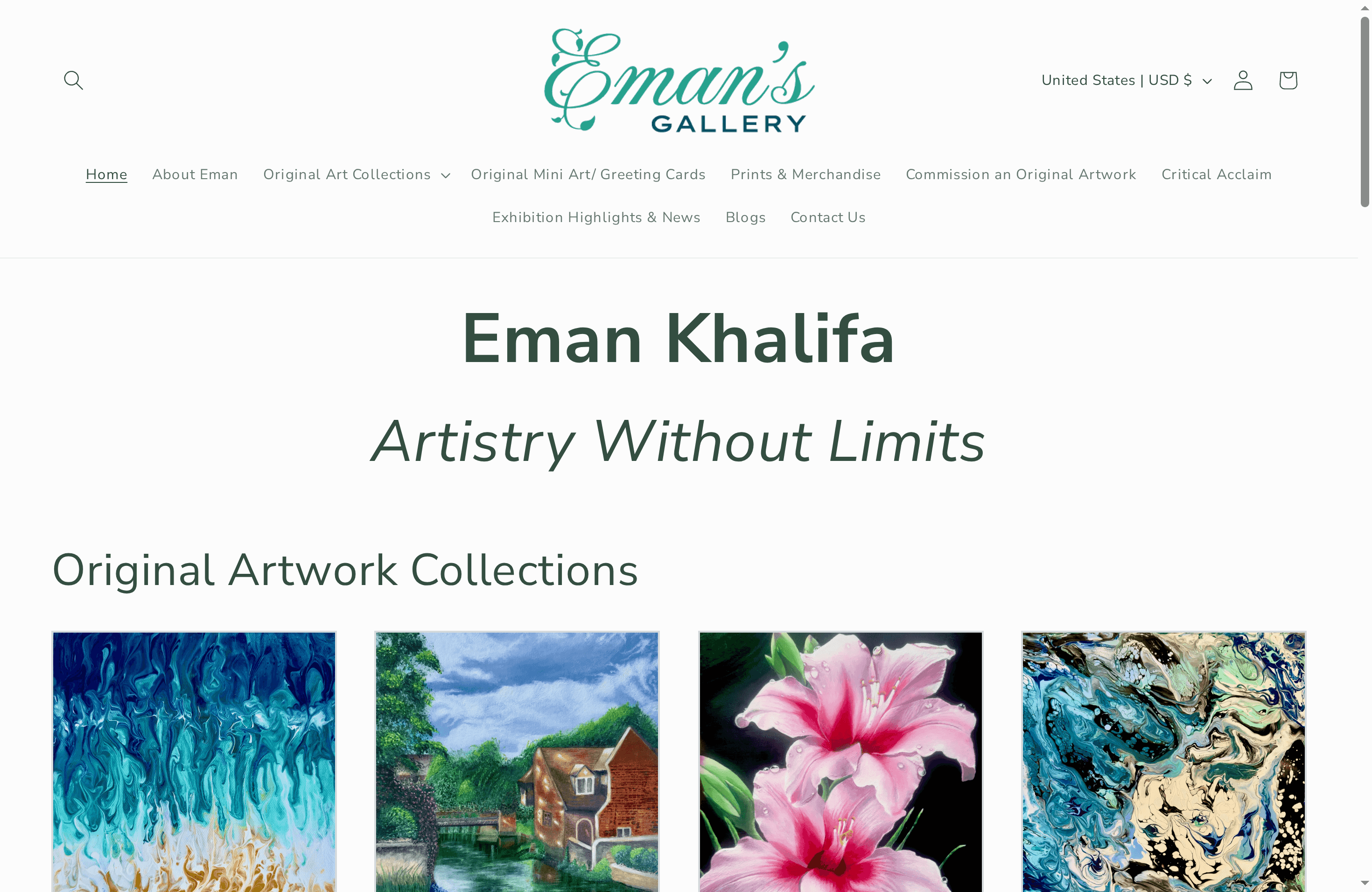
Eman’s Gallery offers original handmade abstract paintings and museum-quality canvas prints that reflect the principles covered in this article: deliberate gesture, structural balance, and genuine emotional content. Each work by artist Eman Khalifa is one of a kind, created with the same commitment to expressive authenticity that defines the Abstract Expressionist tradition. The Good Tidings original painting and the Mystic Sea original are strong examples of fluid abstract work where color and movement carry the full weight of meaning. For collectors and enthusiasts who want to experience meaningful abstractionism in their own space, Emansgallery ships worldwide from the UK, USA, Canada, Australia, and beyond. Browse the full wall art prints collection to find the format that fits your space.
FAQ
What is the definition of abstractionism in art?
Abstractionism is defined as a style of art that communicates meaning through non-representational forms, colors, gestures, and structures rather than depicting recognizable subjects. The meaning resides in the visual and physical properties of the work itself.
How do I know if an abstract painting has real meaning?
A meaningful abstract work demonstrates deliberate compositional structure, consistent internal logic, and a physical or emotional response in the viewer. Research confirms that eminent abstract artists follow measurable structural patterns that distinguish intentional work from random mark-making.
What is the difference between Action Painting and Color Field Painting?
Action Painting, associated with Pollock and de Kooning, derives meaning from the physical process of creation and gestural marks. Color Field Painting, associated with Rothko and Newman, uses large areas of color to produce contemplative or spiritual experiences without relying on gesture.
Why is abstract art considered subversive?
Abstract art allows artists to communicate complex experiences, including trauma, identity, and political resistance, without producing legible imagery that can be censored or co-opted. Abstraction as protection has been particularly significant for artists working outside dominant cultural narratives.
How do I start appreciating abstract art as a beginner?
Begin by noticing your physical and emotional response before attempting to interpret the work intellectually. Track where your eye moves, how color relationships affect your mood, and whether the work holds your attention over time. These responses are the primary data the work is designed to produce.
Stay Connected
- ✨ Explore Eman Khalifa's original art,
- Follow Eman Khalifa's art journey on: Instagram @emans_gallery and Facebook Eman's Gallery
- Watch Eman Khalifa creating live art on: YouTube @emans_gallerye
