


How to Display Art in Your Home: A Practical Guide
TL;DR:
- Displaying art in your home involves precise measurement, quality materials, and thoughtful arrangement for a personal yet professional look. Following the 58 to 60 inch center-height rule and using high-CRI lighting enhances visual impact and color accuracy. Varying display styles across rooms creates visual interest, personalizes your space, and reflects your evolving taste.
Displaying art in your home is the process of arranging and installing artworks to create aesthetic and personal impact within your living space. Done well, it transforms blank walls into curated environments that reflect your taste, history, and design sensibility. The principles behind effective art display draw from museum and gallery practice, including the 57 to 62 inch center-height rule, proper LED lighting with high Color Rendering Index values, and deliberate layout planning. Whether you own your home or rent it, these techniques apply directly to your walls.
How to display art in your home: tools and materials you need first
Before you hang a single piece, gather the right materials. The quality of your display depends as much on preparation as on the art itself.
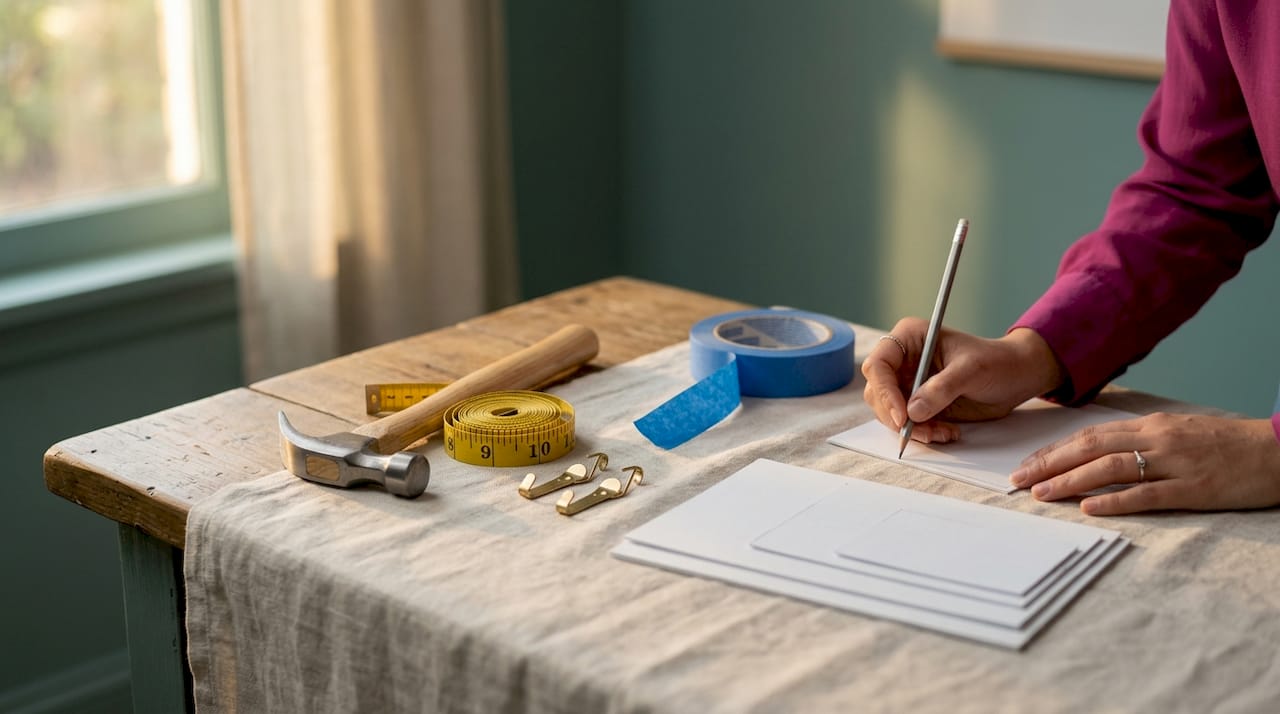
Frames and matting define how a piece reads on the wall. A mat adds visual breathing room between the artwork and the frame edge, making even modest prints look considered and intentional. Standard mat widths run from 2 to 4 inches, with wider mats favoring smaller artworks.
Lighting is where most home displays fall short. LED bulbs with a CRI of 90 or higher render colors accurately and minimize UV damage to pigments over time. Standard LEDs sit at a CRI of 80, which is adequate for general use but noticeably distorts warm tones in paintings and prints. For color temperature, museums target 3000 to 3500 Kelvin to achieve natural, flattering illumination. Anything above 4000K reads as clinical and harsh against most artwork.
Hanging hardware determines long-term stability. Picture hooks rated for your frame weight, wall anchors for drywall, and a reliable level are non-negotiable. For wire-hung frames, use two wall hooks spaced horizontally rather than a single central hook. This cradles the wire at two points and prevents the pendulum tilt that makes frames drift crooked over time.
Pro Tip: Before drilling a single hole for a gallery wall, cut paper templates to match each frame’s dimensions and tape them to the wall with painter’s tape. This paper template method lets you test spacing, alignment, and composition without any wall damage.
| Tool | Purpose |
|---|---|
| High-CRI LED bulbs (90+) | Accurate color rendering, UV protection |
| Two-hook hanging system | Frame stability, prevents tilting |
| Paper frame templates | Layout planning without wall damage |
| Mat board and frames | Visual framing and breathing room |
| Stud finder and level | Secure, straight installation |
How to measure and hang artwork at the right height
The single most common mistake in home art display is hanging pieces too high. The industry standard centers artwork at 57 to 62 inches from the floor, with 58 to 60 inches as the optimal range for average adult eye level. This is the same standard used by galleries and museums worldwide, and it works because it places the visual center of the piece at a natural resting point for the human eye.
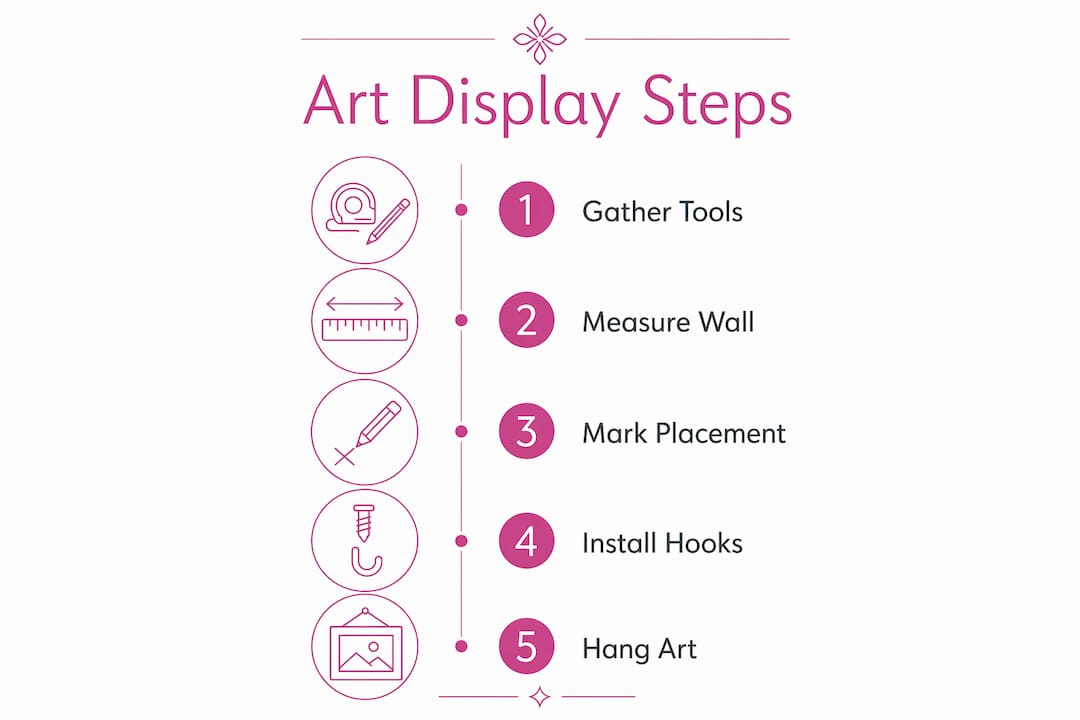
Here is the step-by-step process for calculating your hanging point:
- Measure the height of your artwork and divide by two to find its center.
- Measure from the top of the frame to where the hanging wire or hook sits when taut.
- Subtract the wire-to-top measurement from the center measurement.
- Add that result to your target center height (58 to 60 inches from the floor).
- Mark that point on the wall. That is where your hook goes.
For gallery walls, the same center-height principle applies to the arrangement as a whole, not to each individual piece. Treat the entire cluster as one unit and center that unit at eye level. Spacing between frames in a gallery wall typically runs 2 to 3 inches for a tight, cohesive look, or 4 to 6 inches for a more relaxed arrangement.
Pro Tip: When grouping mixed-media pieces and varied frame sizes, start with the largest piece as your anchor and build outward. Large statement pieces placed where the eye lands first, such as above a fireplace or on the wall directly facing the room’s entry point, create focal anchors that guide the viewer’s attention naturally.
| Scenario | Recommended spacing |
|---|---|
| Tight gallery wall | 2 to 3 inches between frames |
| Relaxed gallery wall | 4 to 6 inches between frames |
| Single statement piece | Centered at 58 to 60 inches from floor |
| Art above furniture | 6 to 8 inches above the furniture top |
For art hung above furniture, such as a sofa or console table, keep the bottom of the frame 6 to 8 inches above the furniture surface. This visually connects the art to the furniture rather than leaving it floating on the wall. You can find more detailed expert hanging guidance including specific calculations for different wall configurations at Emansgallery.
What are the best art display ideas for a dynamic, personalized space?
The most effective home displays avoid repeating the same configuration on every wall. Varying art arrangements across different walls in the same room creates visual interest and keeps the eye moving. One wall might hold a single large canvas, another a gallery cluster, and a third a mix of a mirror and two smaller pieces. This approach prevents the visual monotony that makes a room feel like a showroom rather than a home.
Here are the most effective art display ideas for creating a personalized space:
- Large statement pieces work best on walls with clear sightlines, such as the wall facing your main seating or the first wall visible from the room’s entry.
- Gallery walls suit spaces where you want to tell a story or group related works. Mix photography, paintings, and prints for texture and variety.
- Ledge and shelf displays offer the most flexibility. Rotating and layering art on ledges allows you to refresh your display seasonally without touching a single wall hook.
- Sculptures and three-dimensional objects add depth that flat art cannot. Placing a small sculpture on a pedestal beside a framed painting creates a layered, collected feel.
- Mirrors function as both art and light amplifiers. A well-placed mirror in a gallery arrangement reflects natural light and visually expands the space.
When mixing frame styles, the key is a shared unifying element across at least half the frames. That element can be a consistent mat color, a shared material like wood or metal, or a repeated finish such as matte black. Without it, a mixed-frame gallery wall reads as accidental rather than curated.
Pro Tip: For a salon-style wall that feels collected rather than chaotic, choose one mat color and apply it to every framed piece regardless of frame style. The mat acts as a visual equalizer across diverse frame materials and artwork types.
For more interior art display ideas tailored to modern homes, Emansgallery has a dedicated resource covering rotation strategies and curation approaches.
How to adapt your art display to different rooms and small spaces
Room function directly shapes how art should be displayed. The living room tolerates the most visual complexity, making it the right place for gallery walls and large-scale statement pieces. The bedroom calls for calmer, more personal selections placed at a lower eye level since you often view bedroom art from a seated or reclined position. Entryways benefit from a single strong piece that sets the tone for the entire home.
Kitchens are an underused canvas. Small framed prints, ceramic tiles, or a single bold canvas above open shelving add personality without competing with the room’s functional demands. Avoid paper-based works in kitchens without glass protection, as humidity and grease accelerate deterioration.
Small spaces require a different logic entirely. The instinct to use only small art in small rooms is wrong. One large, bold piece on a compact wall creates a focal point that makes the room feel intentional and expansive. For displaying art in small spaces with maximum impact, scale up rather than down.
Vertical arrangements work well in narrow hallways and stairwells, drawing the eye upward and making low-ceiling spaces feel taller. Layering smaller pieces in front of larger ones on a shelf or ledge adds depth without consuming additional wall space. Mixing artwork with personal mementos creates a living collection that evolves with your household history and adds genuine warmth to any room.
Protection matters more in some rooms than others. Bathrooms and kitchens require UV-protective glass or acrylic glazing for framed works. Direct sunlight fades pigments in both original paintings and prints, so position art away from south-facing windows or use UV-filtering window film.
Key takeaways
Effective home art display combines precise measurement, quality materials, and deliberate arrangement to create spaces that feel both professional and personal.
| Point | Details |
|---|---|
| Use the 58 to 60 inch rule | Center every artwork at 58 to 60 inches from the floor for natural eye-level viewing. |
| Invest in high-CRI lighting | Choose LED bulbs with CRI 90 or higher and 3000 to 3500 Kelvin for accurate color and UV protection. |
| Vary configurations per wall | Use different display styles on each wall to create visual flow and avoid monotony. |
| Unify mixed-frame gallery walls | Apply one shared element, such as mat color or frame material, to at least half the frames for cohesion. |
| Scale up in small spaces | One large, bold piece creates more impact in a compact room than several small ones. |
What I have learned from displaying art intentionally
Most people hang art too high, too small, and too uniformly. I have seen it repeatedly, and I have done it myself. The instinct is to play it safe, to center everything at shoulder height and keep frames the same size and style. The result is a wall that looks decorated rather than lived in.
The shift happens when you stop treating art as wall covering and start treating it as a collection. A collection has gaps, contrasts, and evolution. It includes pieces you bought because they moved you, not because they matched the sofa. It changes over time as your taste and your life change.
The practical lesson I keep returning to is this: commit to the measurement, then experiment with everything else. The 57 to 62 inch center rule is not a creative constraint. It is the foundation that frees you to take risks with scale, mixing, and arrangement because the fundamentals are already correct.
The other thing I would tell anyone starting out is to buy one piece that genuinely challenges you. Not a print that coordinates with your color scheme, but a work that you are not entirely sure about. Those are the pieces that end up defining a room. If you want help choosing artwork that connects with your home’s aesthetic and your personal story, that resource is worth reading before you make your next purchase.
— Eman
Original art that works with every display technique

Emansgallery offers original handmade paintings and museum-quality canvas prints by artist Eman Khalifa, spanning abstract, geometric, floral, landscape, seascape, and still-life styles. Every piece ships worldwide from fulfillment centers in the UK, USA, Canada, Australia, Germany, France, and beyond. Whether you are building a gallery wall, searching for a statement anchor piece, or looking for a canvas print that works in a compact space, the collection covers all scales and aesthetics. The Good Tidings original painting in fluid blue and gold is a strong example of a large-format anchor piece. For versatile print options, browse the full wall art prints collection at Emansgallery.
FAQ
What height should I hang artwork on my wall?
Center artwork at 58 to 60 inches from the floor to the middle of the piece. This matches average adult eye level and is the standard used by professional galleries worldwide.
How do I create a gallery wall without damaging my walls?
Cut paper templates to match each frame’s dimensions and tape them to the wall with painter’s tape before drilling. This lets you test the full layout and adjust spacing without any permanent marks.
What lighting is best for displaying art at home?
Use LED bulbs with a Color Rendering Index of 90 or higher and a color temperature between 3000 and 3500 Kelvin. This combination renders colors accurately and protects artwork from UV damage over time.
How do I mix different frame styles without it looking chaotic?
Apply one unifying element, such as a consistent mat color or shared frame material, to at least half the frames in your arrangement. That single shared thread creates visual cohesion across diverse styles and sizes.
Can I display large art in a small room?
One large, bold piece on a compact wall creates a stronger focal point than several small pieces. Scaling up in small spaces makes the room feel intentional and visually expansive rather than cluttered.
Stay Connected
- ✨ Explore Eman Khalifa's original art, fine art prints and art-inspired merchandise.
- Follow Eman Khalifa's art journey on: Instagram @emans_gallery and Facebook
- Watch Eman Khalifa creating live art on: YouTube @emans_gallery
