


Modern Artwork Examples: A Buyer's Guide for 2026
TL;DR:
- Modern art emphasizes personal expression, experimentation, and cultural response over technical realism.
- Contemporary works often involve diverse materials, digital tools, and conceptual themes that challenge traditional formats and ideas.
Modern art is defined as work that breaks from academic tradition, prioritizing personal expression, experimentation, and response to cultural change over technical conformity. The movement originated in mid-19th-century France as artists reacted to rapid societal and technological shifts. Today, a modern artwork example can range from a large-scale oil painting to a browser-based generative installation that evolves in real time. This guide covers the most instructive examples across styles, materials, and concepts, so you can build your eye and buy with confidence.
1. What are iconic modern artwork examples from the 20th century?
The most studied examples of modern paintings come from movements like Fauvism, Cubism, and Abstract Expressionism. Each movement produced landmark works that redefined what a painting could do.
Key examples include:
- Fauvism: Henri Matisse’s Woman with a Hat (1905) used raw, non-naturalistic color to express emotion rather than describe reality.
- Cubism: Pablo Picasso’s Les Demoiselles d’Avignon (1907) fractured the human figure into geometric planes, rejecting single-point perspective entirely.
- Abstract Expressionism: Mark Rothko’s large color-field canvases used scale and saturated hue to produce a near-physical emotional effect on viewers.
- Pop Art: Andy Warhol’s Campbell’s Soup Cans (1962) treated commercial imagery as fine art, collapsing the boundary between high culture and mass production.
These works share one defining quality: they prioritize the artist’s idea over realistic representation. That shift is the foundation of every contemporary art example you will encounter today.
2. Iconic 21st-century paintings that set the standard
Iconic 21st-century modern artworks include Luc Tuymans’ Still Life (2002), Julie Mehretu’s Stadia II (2004), and Gerhard Richter’s Cage 1–6 (2006). These pieces illustrate the shift toward conceptualism and diverse abstraction in contemporary art.
Each work rewards close attention:
- Luc Tuymans’ Still Life (2002): Muted, almost bleached color creates psychological unease. The painting looks quiet but carries a deeply unsettling undertone about violence and memory.
- Julie Mehretu’s Stadia II (2004): Layered architectural diagrams and gestural marks create a dense visual field. The work addresses globalization, crowd dynamics, and urban power structures simultaneously.
- Gerhard Richter’s Cage 1–6 (2006): Six large canvases built from layers of squeegeed paint reference both John Cage’s music and the chaos of pure process. Scale and repetition are central to the meaning.
These examples of contemporary art paintings prove that scale, technique, and conceptual framing work together. A painting is not just a surface. It is an argument.
3. How contemporary digital art redefines the modern artwork example
Digital and generative works represent the fastest-growing category in contemporary art examples. Craig Munro’s Scatter series uses generative code to produce over 5 trillion unique iterations. That number means no two collectors own the same image, making each output genuinely one of a kind.
Key examples of digital and interactive contemporary art:
- Craig Munro’s Scatter V: Generative code produces unique visual outputs at a scale impossible for any human hand. The work exists at the intersection of mathematics and aesthetics.
- Zoi Roupakia’s Apophenia (2026): This browser-based piece uses AI within the browser to create evolving visuals. No data leaves the user’s device, making it both technically sophisticated and privacy-conscious.
- Julie Mehretu’s layered abstraction: While painted by hand, Mehretu’s process mirrors digital layering, stacking transparent marks to build visual complexity.
Pro Tip: When researching digital art for purchase, ask the artist or gallery for a full list of software dependencies. A work that runs on today’s browser may require updates or emulation in five years.
4. Which materials and formats appear in modern artwork examples?
Modern and contemporary art uses a wider range of materials than any previous period in art history. The shift from canvas and oil to glass, code, and mixed media reflects the field’s core commitment to experimentation.
| Format | Example | Key Feature |
|---|---|---|
| Large-scale canvas | Nikolaus Kriese’s Lazarus (280 x 140 cm) | Physical presence dominates the room |
| Kiln-fired glass and mixed media | Monika Tkaczyk’s The Geometry of Passage | Combines light transmission with symbolic geometry |
| Generative digital | Craig Munro’s Scatter V | Over 5 trillion unique outputs |
| Net-Art / browser-based | Zoi Roupakia’s Apophenia (2026) | Runs locally; no server dependency |
| Oil and acrylic on canvas | Emansgallery original paintings | Handmade, one of a kind, ships worldwide |
Modern artworks challenge traditional materials, with Net-Art and generative works relying on collaboration between viewer and machine to complete the experience. That collaboration is not a gimmick. It changes what ownership means.
Pro Tip: For physical works, always confirm canvas size against your wall space before purchasing. A 280 cm canvas that looks balanced in a gallery can overwhelm a standard residential room.
5. How conceptual themes define the best contemporary art examples
The strongest examples of contemporary art paintings carry a clear conceptual argument. The work is not just visually interesting. It makes a claim about the world.
The Transparent Terms is a minimalist Net-Art piece that critiques user passivity in digital environments through concealed text and interactive loops. It uses digital steganography to hide its content in plain sight, forcing viewers to question what they accept without reading. The work functions as institutional critique of surveillance capitalism, delivered through the very medium it critiques.
“Successful modern artworks engage viewers to contemplate complex internal experiences, blurring the boundary between human and machine perception. The viewer does not observe the work. The viewer completes it.”
Monika Tkaczyk’s The Geometry of Passage combines kiln-fired glass with mixed media to explore psychological and spiritual transitions. Symbolic geometry and controlled light evoke internal thresholds that language cannot easily describe. The physical material, glass that transmits and refracts light, becomes the argument itself.
Many modern digital artworks are incomplete without viewer interaction, relying on active inputs to evolve and exist as intended. This is a fundamental departure from the passive gallery experience. Buying such a work means accepting a role as co-author.
6. How to read modern art styles and techniques as a buyer
Understanding the technique behind a work helps you evaluate its quality and price. Modern art techniques fall into several clear categories, each with distinct visual signatures.

Gestural abstraction uses fast, expressive brushwork to record the physical act of painting. Franz Kline’s black and white compositions and de Kooning’s figure paintings are the canonical references. When you see this technique in a contemporary work, look for evidence of genuine process: drips, layering, and visible revision.
Color field painting uses large areas of flat or near-flat color to produce perceptual effects. The technique depends entirely on scale and the relationship between adjacent hues. A small reproduction never captures the effect. Seeing color field work in person is the only reliable way to judge it.
Geometric abstraction builds compositions from precise shapes and mathematical relationships. This approach appears in both traditional painting and digital generative art. Emansgallery’s geometric abstract works apply this logic to urban imagery, producing structured compositions that work well in modern interiors.
Fluid and pour techniques use gravity and controlled flow to create organic, non-repeatable patterns. No two pour paintings are identical. This technique produces the kind of visual complexity that rewards long looking, which makes it well suited to living spaces where you spend extended time.
7. What abstract art examples reveal about modern art’s range
Abstract art examples span the full spectrum from near-total chaos to strict geometric order. The range matters because it means there is an abstract work for almost every interior context and personal preference.
At one end, pure gestural abstraction like Jackson Pollock’s drip paintings records physical energy directly. The canvas becomes a document of the artist’s movement. At the other end, hard-edge abstraction like Frank Stella’s shaped canvases uses precise geometry to eliminate any trace of the hand.
Between those poles, fluid abstraction occupies a middle ground that many buyers find most accessible. Works in this category combine organic movement with deliberate color relationships. Emansgallery’s original paintings, including fluid ocean abstracts like Good Tidings and Mystic Sea, sit in this category. They carry visual complexity without requiring art-historical knowledge to appreciate.
For buyers new to abstract art, the modern abstract art trends guide at Emansgallery provides a practical framework for identifying which styles suit your space and taste.
8. How to evaluate a modern artwork example before buying
Buying modern art requires three separate evaluations: visual, conceptual, and practical. Most buyers focus only on the first and regret skipping the other two.
Visual evaluation asks whether the work holds your attention across multiple viewings. A piece that reads well in a photograph but feels flat in person is a common disappointment. Whenever possible, request a high-resolution image or, for physical works, a studio visit or gallery viewing.
Conceptual evaluation asks what the work is about and whether that argument matters to you. You do not need to agree with the artist’s position. You do need to find it interesting enough to live with.
Practical evaluation covers size, medium, and maintenance. Artists advise verifying installation requirements before acquisition to ensure longevity and accessibility, particularly for digital works. For physical paintings, confirm framing, hanging hardware, and light sensitivity before purchase. Emansgallery provides detailed product information for each original work, including dimensions and care guidance.
For display ideas once you have made a purchase, the interior art display guide at Emansgallery covers practical arrangements for modern homes.
Key takeaways
Modern art’s defining quality is the primacy of idea over technique, and the best examples prove that claim through scale, material, and conceptual precision.
| Point | Details |
|---|---|
| Origins define the field | Modern art broke from academic tradition in mid-19th-century France and evolved into Fauvism, Cubism, and beyond. |
| Scale and material carry meaning | From 280 cm canvases to browser-based generative works, format is part of the argument. |
| Conceptual depth separates good from great | The strongest contemporary examples make a clear claim about the world, not just a visual impression. |
| Digital art requires technical due diligence | Verify software dependencies and display requirements before acquiring any generative or Net-Art work. |
| Fluid abstraction suits most buyers | Works combining organic movement with deliberate color relationships are accessible without art-historical background. |
What I have learned from living with modern art
The advice I see repeated most often about buying modern art is “buy what you love.” That is true but incomplete. What you love at first glance is not always what you want to live with for ten years.
The works that hold up longest are the ones that give you something new each time you look. That quality is not accidental. It comes from conceptual layering, the kind you see in Mehretu’s stacked architectural marks or in a well-executed fluid painting where the color relationships shift depending on the light in the room. Purely decorative work tends to flatten out after a few months.
I have also found that buyers consistently underestimate the importance of scale. A painting that looks modest online can transform a wall completely in person. The reverse is equally true. Before committing to any large-scale work, I recommend printing a paper template at the actual dimensions and taping it to your wall for a week. That single step prevents most sizing regrets.
For digital and interactive works, the practical considerations are real. Digital artworks executed locally using machine learning require buyers to understand software dependencies and user environment constraints for proper display and preservation. That is not a reason to avoid digital art. It is a reason to ask the right questions before you buy.
The art market rewards patience. Take time with each piece. If it still interests you after a week of looking, that is a reliable signal.
— Eman
Original modern art available at Emansgallery
Emansgallery offers original handmade paintings and museum-quality canvas prints by artist Eman Khalifa, shipped worldwide from studios in the UK, USA, Canada, Australia, and across Europe.
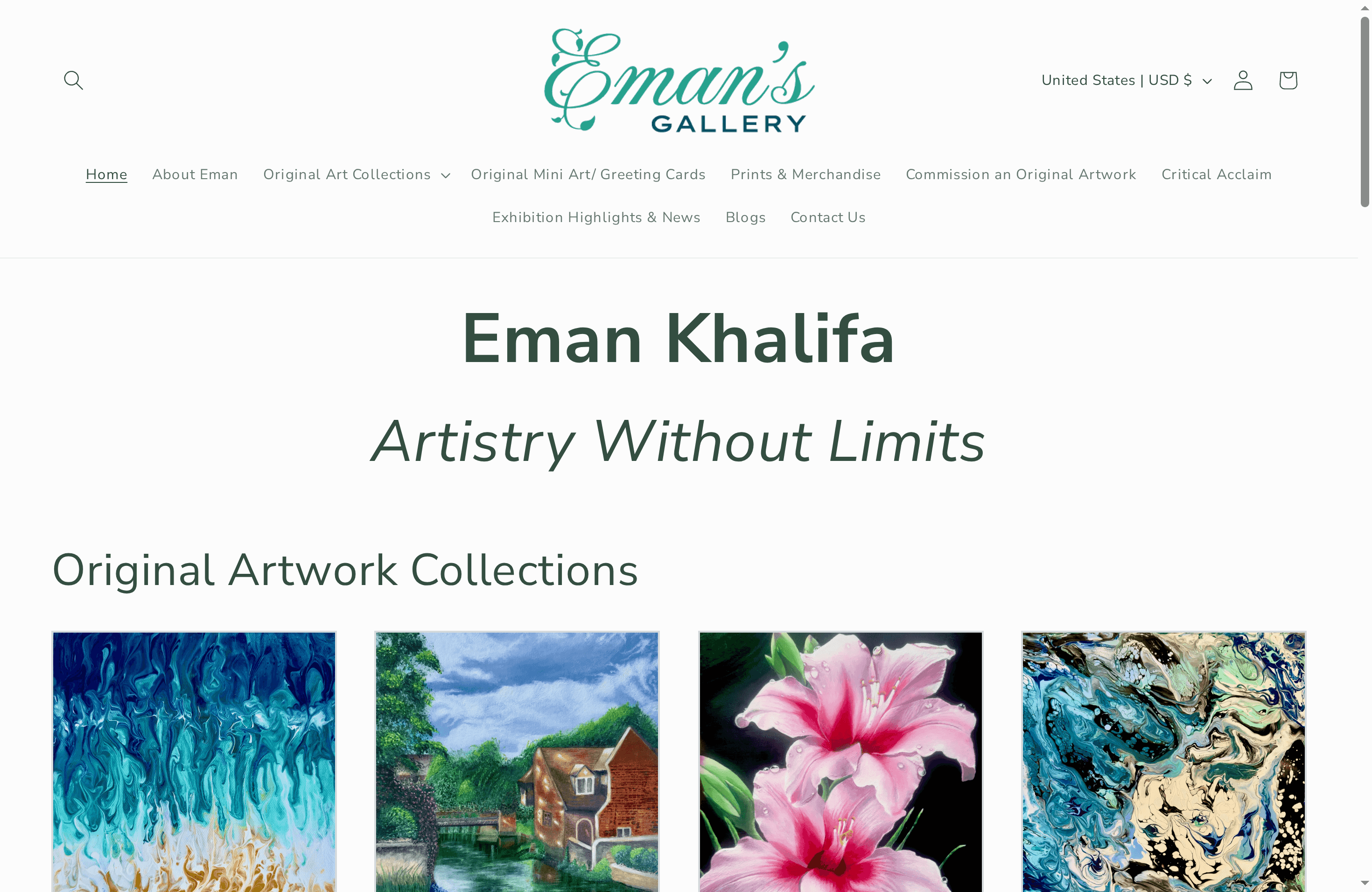
The collection covers fluid abstraction, geometric compositions, seascapes, and conceptual works. Each original painting is one of a kind. The Good Tidings original painting exemplifies the fluid blue and gold ocean style that works across modern and transitional interiors. For conceptual themes, the Private Eye canvas print brings expressionist depth to any wall. Browse the full range of wall art prints to find the right piece for your space and budget.
FAQ
What is a modern artwork example?
A modern artwork example is any work that prioritizes personal expression, conceptual argument, or experimental technique over academic realism. Modern art originated in mid-19th-century France and includes styles from Fauvism and Cubism to digital generative art.
What are the most recognized examples of modern paintings?
The most recognized examples include Picasso’s Les Demoiselles d’Avignon, Rothko’s color-field canvases, and 21st-century works like Julie Mehretu’s Stadia II (2004). Each represents a distinct approach to abstraction and conceptual depth.
How do contemporary art examples differ from modern art?
Modern art generally refers to work from roughly 1860 to 1970, while contemporary art covers work made after 1970 to the present. In practice, the terms overlap, and many buyers use them interchangeably when describing non-representational or experimental work.
What should I check before buying a digital modern artwork?
Verify the software and hardware requirements, confirm whether the work runs locally or requires a server, and ask the artist about long-term preservation. Artists advise verifying installation requirements before acquisition to ensure the work remains displayable as technology changes.
Where can I find original modern artworks to buy?
Emansgallery offers original handmade paintings and canvas prints in abstract, geometric, and seascape styles, with worldwide shipping. The guide to buying original contemporary paintings at Emansgallery covers what to look for when purchasing from an online gallery.
Stay Connected
- ✨ Explore Eman Khalifa's original art, fine art prints and art-inspired merchandise.
- Follow Eman Khalifa's art journey on: Instagram @emans_gallery and Facebook
- Watch Eman Khalifa creating live art on: YouTube @emans_gallery
