


What Is Modern and Contemporary Art? A Clear Guide
TL;DR:
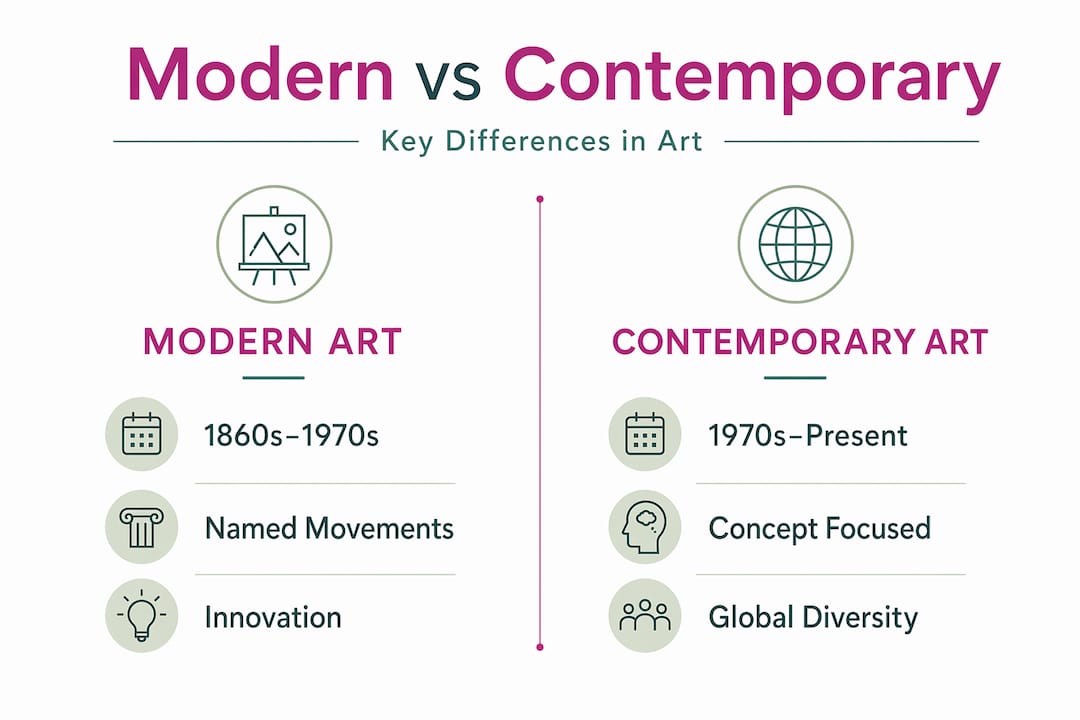
- Modern art, spanning from the 1860s to the 1970s, focuses on aesthetic innovation and universal truths.
- Contemporary art, from the 1970s onward, emphasizes conceptualism, social dialogue, and diverse mediums.
Most people use “modern” and “contemporary” as if they mean the same thing. In art, they do not. Understanding what is modern and contemporary art requires knowing that these are two distinct historical periods with different philosophies, mediums, and cultural purposes. Modern art is a closed chapter, roughly 1860s to 1970s. Contemporary art is still being written. The confusion is understandable, but the distinction matters, especially if you are collecting, decorating, or simply trying to make sense of what you see on a gallery wall.
Table of Contents
- Key takeaways
- What is modern and contemporary art, starting with modern
- Contemporary art explained: what makes it different
- Differences between modern and contemporary art
- How to appreciate modern and contemporary art
- My perspective on why this distinction actually matters
- Explore original art at Eman’s Gallery
- FAQ
- Stay Connected
Key takeaways
| Point | Details |
|---|---|
| Modern art has fixed dates | Modern art spans roughly the 1860s to 1970s, defined by aesthetic innovation and a belief in progress. |
| Contemporary art is ongoing | Contemporary art covers 1970s to present, defined by conceptualism, pluralism, and social dialogue. |
| Philosophy separates them most | Modern art sought universal truths; contemporary art questions whether universal truths exist at all. |
| Medium expanded dramatically | Contemporary art includes installation, performance, digital, and street art, not just painting and sculpture. |
| Market trends differ sharply | Impressionist and Modern art sales reached $4.7 billion in 2025, while ultra-contemporary sales declined. |
What is modern and contemporary art, starting with modern
Modern art is not just old art. It is a specific movement with a beginning, a middle, and an end.
Modern art emerged in the late 19th century as a direct response to the Industrial Revolution and the invention of photography. When cameras could capture reality precisely, painters no longer felt obligated to do the same. That single technological shift freed artists to experiment with abstraction, emotion, and form in ways that had no precedent.
The period runs from approximately the 1860s through the 1970s. Within that window, you find some of the most recognizable names in art history: Monet, Picasso, Dali, Pollock, Rothko. Each worked within a defined movement, and those movements had names and rules, even when the rules were about breaking other rules.
Key movements within modern art include:
- Impressionism (1860s): Focused on capturing light and fleeting moments, rejecting photographic realism.
- Cubism (1900s): Broke objects into geometric fragments and showed multiple perspectives simultaneously, most famously by Picasso.
- Surrealism (1920s): Drew on dreamlike imagery and the unconscious mind, with Dali and Magritte as central figures.
- Abstract Expressionism (1940s–50s): Prioritized emotional intensity and spontaneous mark-making. Think Pollock’s drip paintings.
- Minimalism (1960s–70s): Stripped everything down to the bare essentials of form and color.
What united all of these movements was a belief in linear progress and aesthetic innovation. Modern artists genuinely believed art could improve, could discover something true about human experience, and could change the world. That optimism is baked into the DNA of every movement listed above.
Pro Tip: When you visit a modern art museum, look at the labels. If the work has an “ism” attached to it, Cubism, Surrealism, Expressionism, you are looking at modern art. Contemporary art resists those neat categories.
Contemporary art explained: what makes it different
Contemporary art is not simply art made today. The distinction is conceptual, not just chronological.
Contemporary art covers the period from the 1970s to the present and is defined above all by the rejection of grand narratives. Where modern artists believed in universal truths and artistic progress, contemporary artists are skeptical of both. They ask questions rather than assert answers. They embrace contradiction, irony, and ambiguity as legitimate artistic tools.

The shift happened gradually, with postmodernism serving as the transitional force between the two eras. Postmodernism pushed back on strict structures and gave artists permission to borrow freely across history, cultures, and mediums without committing to any single ideology. That freedom produced the diversity you see in contemporary art today.
Contemporary art is also profoundly social. It functions as a living conversation that requires audience participation and focuses on identity, politics, and culture rather than pure aesthetic beauty. A painting of a woman is not just a painting. It might be a commentary on race, gender, the male gaze, colonial history, or all four at once.
Mediums expanded far beyond canvas and marble. Contemporary art includes:
- Installation art: Large-scale, often immersive environments built specifically for a gallery or public space.
- Performance art: The artist’s body and actions become the artwork itself.
- Digital and video art: Screens, algorithms, and code as creative tools.
- Street art: Public walls as canvas, from Banksy to muralists working in Lagos, São Paulo, and Melbourne.
- Conceptual art: Where the idea itself is the work, not the physical object.
Contemporary art defies strict categorization by style and is best understood through medium or concept. It is also diverse, global, and dynamic, drawing from artists and cultures across every continent rather than centering almost exclusively on Western Europe and North America the way modern art did.
Pro Tip: When viewing contemporary art, try this: instead of asking “what does this look like?” ask “what is this doing?” That shift in question almost always unlocks the work.
Differences between modern and contemporary art
The differences between modern and contemporary art go well beyond dates. Here is a direct comparison across several key dimensions.
| Dimension | Modern art (1860s–1970s) | Contemporary art (1970s–present) |
|---|---|---|
| Timeline | Fixed historical period | Open and ongoing |
| Core philosophy | Belief in progress and universal truth | Skepticism, pluralism, no single ideology |
| Artistic mediums | Primarily painting, sculpture, printmaking | Painting, installation, performance, digital, video, street art |
| Geographic scope | Predominantly Western European and American | Truly global, diverse cultural origins |
| Audience role | Passive viewer observing the work | Active participant, often part of the work itself |
| Tone | Earnest, mission-driven, idealistic | Ironic, ambiguous, self-aware |
| Categorization | Organized into named “isms” and movements | Resists categories; defined by concept or medium |
One distinction rarely discussed outside academic circles is the tonal difference. Modern art was optimistic about progress and truth, while contemporary art embodies skepticism and plays with contradictions within single works. You can feel this difference when you stand in front of a Mondrian versus a work by Kara Walker or Ai Weiwei.
“Contemporary art is best understood as a cultural dialogue, evolving continuously with social, political, and technological changes worldwide.” — Google Arts & Culture
Understanding this shift also helps you understand why contemporary art sometimes frustrates viewers expecting beauty or technical skill. It was never about those things. For a deeper look at how modern art styles are categorized, the modern art styles guide at Eman’s Gallery breaks down each movement with collector-relevant context.
How to appreciate modern and contemporary art
Appreciating art in either period requires one central adjustment: suspend the expectation that good art looks a certain way.
Art appreciation requires understanding context, artist intention, and the social or conceptual framework rather than judging by traditional beauty standards. That does not mean anything counts as art. It means you need different tools to evaluate different works.
Here is a practical approach for both periods:
- Read the label. The title and date of a work tell you more than most people realize. A Picasso titled Weeping Woman and dated 1937 connects directly to the Spanish Civil War. That context changes everything.
- Identify the medium. If it is oil on canvas, you are likely dealing with modern or earlier work. If it is a video loop, a room full of objects, or a digital print, you are in contemporary territory.
- Ask about intention. What was the artist trying to do, not what did they make? This is the central question in contemporary art, where concept and process carry value as much as the finished object.
- Look for cultural context. Contemporary art is global. A work by a South African artist will carry references that a European artist simply would not. Research the artist’s background.
- Resist the “I could do that” reaction. You could not, and more importantly, you did not. The idea, the timing, the cultural positioning of a work are all part of what makes it significant.
For collectors specifically, understanding both periods has financial implications. Impressionist and Modern art sales reached $4.7 billion in 2025, a 29.5% increase, while ultra-contemporary art sales declined by 26.5%. That market divergence suggests modern art carries stronger investment stability right now, while contemporary work offers higher risk with potentially higher long-term cultural relevance. For more on building a collection wisely, the art collector tips from Eman’s Gallery are worth reading alongside the contemporary art investment guide for 2026.
Pro Tip: Do not buy art solely as investment. Buy what you can live with on your wall for twenty years. The best collections are built by people who genuinely love what they own.
My perspective on why this distinction actually matters
I have had countless conversations with people who dismiss contemporary art because they find it confusing or visually unappealing. And I have had equally as many conversations with people who consider modern art stuffy and museum-bound. Both reactions miss something.
In my experience, the confusion between these two periods is not just semantic. It shapes how people engage with living artists, how they value what they buy, and how they understand culture being made right now. When someone tells me they “don’t get” contemporary art, what they usually mean is that no one gave them the right question to ask.
What I have learned from making and studying art is that the labels matter less than the engagement. A piece does not need to fit into modern or contemporary art to be worth your attention. But knowing the difference gives you a map. You stop expecting a Basquiat to look like a Monet and start reading each work on its own terms.
The other thing worth saying: contemporary art is not a departure from modern art. It is a response to it. You cannot fully appreciate the irony and self-awareness running through contemporary work without knowing what it is pushing back against. The history of contemporary art is inseparable from the story of modernism.
Art is not a static object to admire from a distance. It is a record of what people were thinking, fearing, and celebrating at a specific moment in history. Both periods offer that. They just offer it in very different voices.
— Eman
Explore original art at Eman’s Gallery
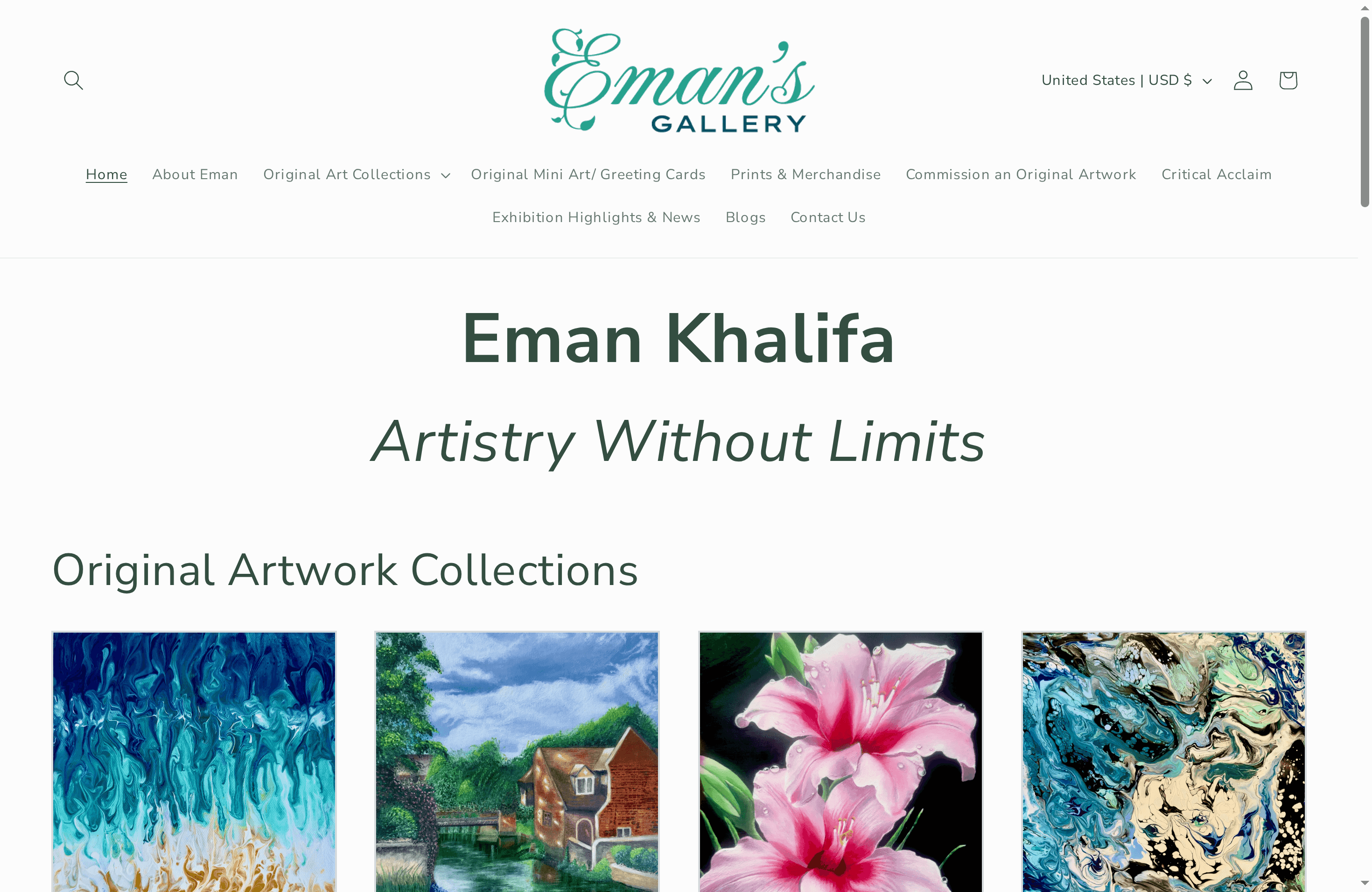
At Eman’s Gallery, artist Eman Khalifa creates original handmade paintings that sit at the intersection of modern formal traditions and contemporary expressive freedom. Her work spans abstract, geometric, floral, seascape, and still-life, with each piece made by hand and available as a one-of-a-kind original or museum-quality canvas print. The Good Tidings original painting in fluid blue and gold is a strong example of this approach, blending color field sensibilities with contemporary gestural energy. For collectors drawn to conceptual work, the Private Eye canvas print demonstrates Eman’s conceptual expressionism. All works ship worldwide from the UK, USA, Canada, Australia, and beyond.
FAQ
What is the difference between modern and contemporary art?
Modern art refers to a specific historical period from the 1860s to the 1970s, defined by aesthetic innovation and named movements like Impressionism and Cubism. Contemporary art covers 1970 to the present and is defined by conceptualism, pluralism, and social or political themes rather than a unified style.
Is modern art still relevant today?
Yes. Impressionist and Modern art sales hit $4.7 billion in 2025, outperforming ultra-contemporary categories significantly. Modern art remains culturally and financially significant, both in major museums and the auction market.
When did contemporary art begin?
Contemporary art generally begins in the 1970s, when postmodernism started dismantling the idealism of modern art and artists shifted focus toward conceptualism, identity politics, and global cultural dialogue.
Why is contemporary art so hard to understand?
Many viewers expect contemporary art to be traditionally beautiful, but its value often lies in concept, process, or social critique rather than visual appeal. Understanding the artist’s intention and cultural context resolves most of the confusion.
Can contemporary art be a good investment?
Contemporary art carries more risk than modern art as an investment. Market data from 2025 shows ultra-contemporary average auction prices dropped to $15,629, while modern works held stronger value. Buying art you genuinely connect with, alongside informed research, remains the most reliable approach for collectors.
Stay Connected
-
✨ Explore Eman Khalifa's original art, fine art prints & art merchandise
-
📸 Follow Eman Khalifa's art journey on: Instagram @emans_gallery and Facebook Eman's Gallery
-
📹 Watch Eman Khalifa creating live art on: YouTube @emans_gallery
-
Supported by BabyLoveGrowth
