


What Is Semi Abstract Art: A Guide for Art Enthusiasts
TL;DR:
- Semi-abstract art features partially recognizable subjects achieved through deliberate distortion and fragmentation. It balances realism and pure abstraction by emphasizing formal elements like color, line, and texture to evoke emotion and mood. Historically rooted in movements like Cubism and biomorphic abstraction, it remains relevant for its expressive versatility and accessibility to beginners.
Semi-abstract art is defined as a visual style in which recognizable subjects are deliberately simplified, fragmented, or distorted so that formal elements like color, line, and shape compete with representational content. The term “semi-abstract” is widely used, though art historians often frame this approach within the broader concept of partial abstraction, a stage on the continuum between realism and pure abstraction. Artists like Pablo Picasso and Joan Miró built entire movements on this balance, producing works that reward both casual viewers and serious collectors. This guide explains the characteristics, techniques, and historical significance of semi-abstract art for anyone looking to understand it more deeply.
What is semi-abstract art and how is it defined?
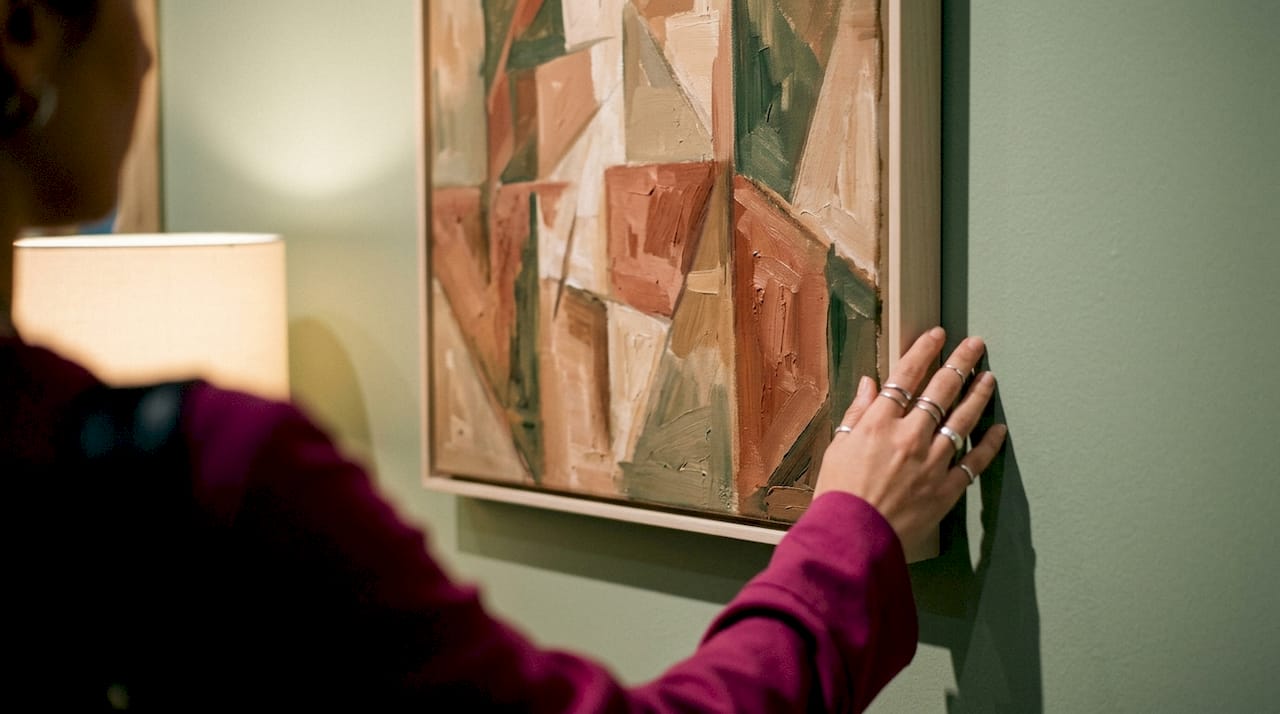
Semi-abstract art sits at the middle ground of the abstraction spectrum where visual elements compete with or override representational content. Viewers can usually identify subjects, but only with effort. The subject has not disappeared entirely. It has been pushed to the edge of recognition.
This distinguishes semi-abstract work from both realism and pure abstraction. Realism prioritizes accurate depiction of the visible world. Pure abstraction abandons recognizable subjects entirely, relying solely on form, color, and composition to communicate. Semi-abstract art occupies the space between these two poles, and that tension is precisely what gives it expressive power.
The definition of semi-abstract art is best understood not as a fixed style but as a position on a spectrum. Picasso’s Cubist portraits, for example, show fragmented human figures that remain identifiable despite geometric breakdown. Joan Miró’s biomorphic compositions retain traces of organic forms while dissolving into color fields. Both artists demonstrate that partial abstraction is a deliberate choice, not an incomplete attempt at realism.
Pro Tip: When you encounter a painting and find yourself asking “is that a figure or a landscape?”, you are likely looking at semi-abstract work. That moment of productive uncertainty is the style’s signature.
What are the defining characteristics of semi-abstract art?
The single most diagnostic characteristic of semi-abstract art is partial recognizability. Viewers can identify subjects but those subjects are simplified or distorted, and visual emphasis shifts toward relationships among color, line, texture, and composition rather than accurate representation. The subject anchors the work; the formal elements carry the meaning.
Several specific characteristics define the style:
- Fragmentation: Subjects are broken into component parts, as in Cubism, where a face might appear from multiple angles simultaneously.
- Distortion: Proportions, shapes, or spatial relationships are altered to serve expressive or compositional goals rather than literal accuracy.
- Selective realism: Some areas of a painting remain detailed and recognizable while others dissolve into flat color or gestural marks.
- Formal emphasis: Color, line, shape, and texture are used to create mood and emotional resonance, not just to describe what something looks like.
- Compositional tension: The interplay between the recognizable and the abstract creates visual energy that purely realistic or purely abstract works cannot achieve.
Color in semi-abstract art functions as both description and emotion. A figure might be rendered in blues and greens that have no literal basis but communicate stillness or melancholy. Texture adds tactile presence that pulls the viewer toward the surface of the canvas rather than through it into an illusory space. These formal decisions are not decorative. They are the primary language of the work.
Pro Tip: When studying a semi-abstract painting, cover the most abstract section and observe how the mood changes. That shift reveals exactly how much expressive weight the non-representational elements are carrying.
How does semi-abstract art fit within the spectrum of abstraction?
Abstraction is a spectrum where formal elements compete with representational content to varying degrees. Semi-abstract art is not a binary category. It is one degree among several on a continuum that runs from photorealistic painting through stylization, semi-abstraction, and into pure non-objective work.
Art guides frame this as a progression of stages rather than distinct genres. At one end, a photorealist painting of a harbor contains every detail of light on water and rope on a dock. Move along the spectrum and the harbor becomes simplified, its shapes flattened, its colors intensified beyond nature. Move further and the harbor is barely suggested by a horizontal band of blue and a vertical smear of gray. Move to the far end and there is no harbor at all, only color and form.
The table below clarifies where semi-abstract art sits relative to realism and pure abstraction:
| Characteristic | Realism | Semi-abstract art | Pure abstraction |
|---|---|---|---|
| Subject recognizability | Fully recognizable | Partially recognizable | Not recognizable |
| Formal element emphasis | Low | High | Dominant |
| Viewer effort required | Minimal | Moderate | Significant |
| Historical examples | Vermeer, Hopper | Picasso, Miró, Mondrian | Kandinsky, Rothko |
| Expressive priority | Accuracy | Balance of form and content | Pure form and emotion |
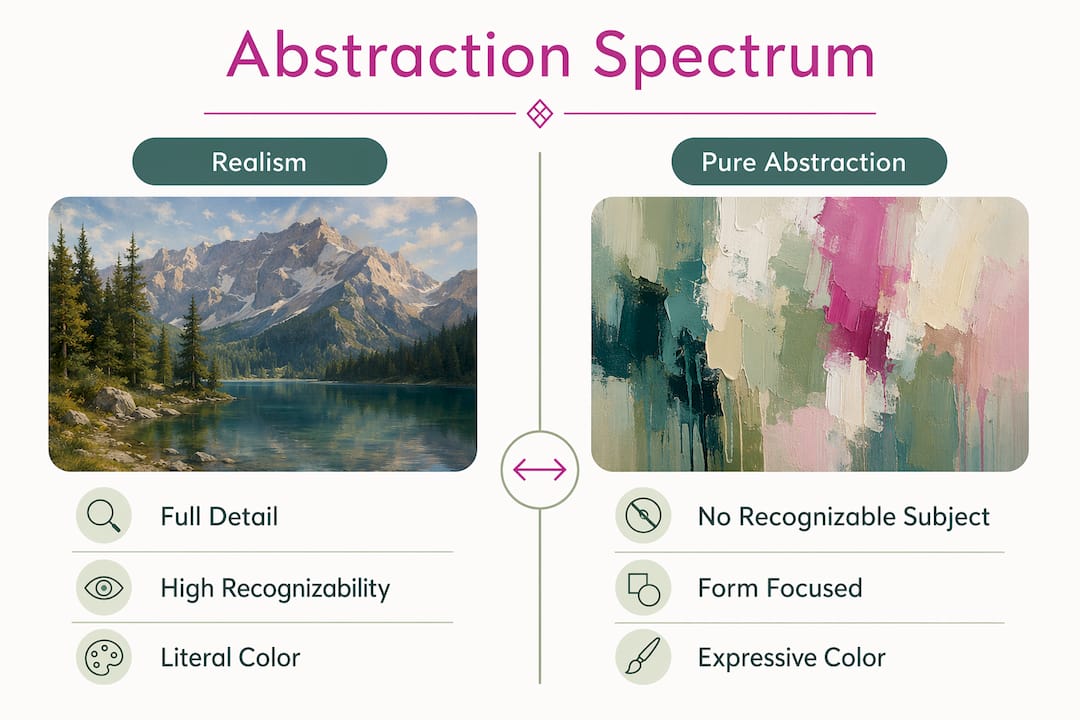
Cubism operates at the semi-abstract level, fragmenting forms into geometric planes that remain identifiable but require viewer effort. Piet Mondrian’s early tree paintings offer a textbook progression: his 1908 trees are recognizable; by 1912 they are geometric grids. That sequence is the entire semi-abstract spectrum compressed into one artist’s career.
To position any work on this spectrum, ask three diagnostic questions. Can you identify a specific object, person, or place? Are the proportions and spatial relationships altered? Do color and texture seem to carry meaning independent of the subject? If the answer to all three is yes, the work is semi-abstract.
What techniques do artists use to create semi-abstract art?
Artists create semi-abstract art by selectively choosing which elements to keep concrete and which to abstract, composing the entire image around that deliberate balance. This is not a passive process. Every decision about where to add detail and where to dissolve form is a compositional choice with expressive consequences.
The following techniques appear consistently in semi-abstract practice:
- Partial disappearance: Lines or edges are allowed to fade or vanish, creating areas where the subject dissolves into the background. This technique produces depth and atmosphere without resorting to traditional perspective.
- Line erasure: Outlines that define a form are selectively removed, leaving the viewer to complete the shape from context and surrounding color.
- Echo repetition: A shape is repeated in slightly altered form across the canvas, creating rhythm and suggesting movement without depicting it literally.
- Geometric integration: Organic forms are replaced with or overlaid by geometric equivalents, as when a figure becomes a series of cylinders and planes.
- Selective color departure: Realistic color is maintained in focal areas while surrounding passages use non-representational color to direct emotional response.
Partial disappearance methods create paintings that read as both constructed and atmospheric. The tension between the solid and the dissolving is what makes semi-abstract work feel alive rather than static. Artist Päivi of Peony and Parakeet describes this as a deliberate negotiation between light, mass, and the spiritual qualities of a subject, where the goal is not to depict a thing but to communicate its essential presence.
For artists beginning to work in this mode, the most productive starting point is a subject you know well. Familiarity with the source material makes it easier to identify which elements carry the most meaning and which can be released into abstraction without losing the work’s legibility.
What is the historical significance of semi-abstract art?
Semi-abstract art as a recognized approach emerged from the early 20th century modernist movements that challenged the dominance of academic realism. Abstraction categories are not binary; semi-abstraction developed as artists found that partial departure from representation gave them expressive freedoms that realism denied without requiring the complete abandonment of the visible world.
Key figures and movements in this history include:
- Pablo Picasso and Georges Braque: Cubism, developed between 1907 and 1914, is the most influential semi-abstract movement in Western art history. Fragmented planes and multiple viewpoints kept subjects recognizable while dismantling conventional pictorial space.
- Joan Miró: Miró’s biomorphic forms retain traces of figures, landscapes, and creatures while operating primarily as color and shape. His work demonstrates that semi-abstraction can be playful and surreal rather than analytical.
- Piet Mondrian: Mondrian’s progression from landscape painting to grid abstraction documents the full semi-abstract spectrum within a single body of work.
- Paul Cézanne: Often cited as the bridge between Impressionism and Cubism, Cézanne’s geometric treatment of natural forms established the conceptual foundation for semi-abstract practice.
Contemporary artists continue to work in this mode across painting, printmaking, and digital media. The modern abstract art trends most visible in gallery and collector markets in 2026 include gestural semi-abstract work that retains landscape or figurative references, and geometric semi-abstraction that draws on urban and architectural forms. The style remains commercially and critically relevant because it communicates to viewers who find pure abstraction inaccessible while offering the expressive range that strict realism cannot provide.
My perspective on understanding semi-abstract art
When I look at a semi-abstract painting, I resist the instinct to decode it. The question “what is it?” is less productive than “what does it do?” A semi-abstract work that makes you feel the weight of a figure or the stillness of water has succeeded, regardless of whether you can name the subject precisely.
What I have found, both in making and in studying this kind of work, is that the most powerful semi-abstract pieces use recognizability strategically. The artist keeps just enough of the subject to give the viewer a foothold, then uses color, texture, and composition to carry them somewhere the literal image could never go. That foothold matters. Without it, the work risks becoming decorative. With it, the abstraction has somewhere to push against.
The common mistake when approaching semi-abstract art is to treat the recognizable elements as the “real” content and the abstract elements as stylistic decoration. The opposite is closer to the truth. Expressive choices in color and texture support the intended mood, and that mood is the work’s actual subject. The figure or landscape is the occasion, not the destination.
For anyone building a collection or developing a practice, I would say this: do not wait until you fully understand a semi-abstract work to respond to it. The response comes first. The understanding follows.
— Eman
Discover original semi-abstract art at Eman’s Gallery
Eman’s Gallery offers original paintings and museum-quality canvas prints that demonstrate the full range of semi-abstract practice, from fluid oceanic compositions to geometric urban forms.
The Fragments of Memory canvas print illustrates partial abstraction through ink splash techniques that retain compositional structure while dissolving literal form. The Private Eye canvas print works in the conceptual expressionist mode, where figurative reference and abstract mark-making operate simultaneously. Each piece ships worldwide from locations including the UK, USA, Canada, Australia, and the UAE. Browse the full wall art prints collection to find semi-abstract works suited to your space and collection.
Key takeaways
Semi-abstract art is defined by partial recognizability, where formal elements carry expressive weight that representational content alone cannot achieve.
| Point | Details |
|---|---|
| Core definition | Semi-abstract art retains recognizable subjects while distorting or simplifying them so formal elements dominate. |
| Spectrum position | It sits between realism and pure abstraction, with Cubism and biomorphic art as primary historical examples. |
| Key techniques | Partial disappearance, line erasure, echo repetition, and selective color departure are the defining methods. |
| Historical roots | Picasso, Miró, Mondrian, and Cézanne established the conceptual and visual foundations of the style. |
| Viewing approach | Focus on mood and compositional balance rather than subject accuracy when evaluating semi-abstract works. |
FAQ
What is the simplest definition of semi-abstract art?
Semi-abstract art is a style in which recognizable subjects are simplified or distorted so that color, line, and composition carry as much meaning as the subject itself. The viewer can identify what is depicted, but the formal elements are equally important to the work’s effect.
How is semi-abstract art different from pure abstraction?
In pure abstraction, no recognizable subject exists and the work communicates entirely through form and color. Semi-abstract art retains partial recognizability, giving viewers a subject to identify even as formal elements compete with or override that representation.
What are the best-known examples of semi-abstract art?
Picasso’s Cubist portraits, Joan Miró’s biomorphic compositions, and Mondrian’s early tree paintings are the most widely cited examples. Each retains identifiable subjects while using fragmentation, distortion, or geometric simplification to shift emphasis toward formal elements.
Can beginners create semi-abstract art?
Semi-abstract art is accessible for beginners because it does not require the complete abandonment of representational skill. Starting with a familiar subject and selectively abstracting specific areas, using techniques like line erasure or color departure, produces semi-abstract results without requiring mastery of pure non-objective composition.
How do I know if a painting is semi-abstract or fully abstract?
Ask whether you can identify any specific object, figure, or place in the work. If you can, even with effort, the painting is semi-abstract. If no recognizable reference exists and the work communicates only through color, shape, and texture, it is pure abstraction.
Stay Connected
- ✨ Explore Eman Khalifa's original art, fine art prints and art-inspired merchandise.
- Follow Eman Khalifa's art journey on: Instagram @emans_gallery and Facebook
- Watch Eman Khalifa creating live art on: YouTube @emans_gallery
