


The Best Wall Hangings for Your Living Room: 2026 Guide
For most living rooms, three types of wall hangings consistently deliver the strongest results: an oversized original painting or large canvas print for a focal wall, a textured textile or woven hanging for warmth on a large empty wall, and a dimensional sculpture or statement mirror to add light and depth. Each solves a different spatial problem.
- Focal point above a sofa: An oversized canvas or original painting anchors the seating area and gives the eye a clear destination.
- Textural warmth on a bare wall: A tapestry, macramé panel, or woven hanging adds acoustic softness and visual interest without competing with furniture.
- Light and space expansion: A large mirror or metallic wall sculpture reflects natural light and makes a room feel larger.
Start here: Measure your wall width and your sofa width before you shop. For most living rooms, a single piece hung above a sofa is best sized to cover a significant portion of the sofa’s width.
Key Takeaways
| Point | Details |
|---|---|
| Size to your furniture | Target 60–75% of sofa width for a single piece hung above it; treat grouped pieces as one unit. |
| Pick one wall strategy | Choose oversized single piece, gallery wall, or layered ledges per wall to avoid visual noise. |
| Match material to lifestyle | Textiles add warmth; metal and sealed wood suit high-traffic homes; canvas prints offer color fidelity. |
| Install with double fixings | Use D-rings on both sides and rated anchors; never hang above heat sources or radiators. |
| Emansgallery for originals and prints | Original paintings and museum-quality canvas prints ship worldwide; commissions available with 4–12 week lead times. |
Table of Contents
- What types of wall hangings work best in living rooms?
- How do you choose the right size and placement?
- Practical styling approaches that actually work
- How do materials and finishes affect mood and durability?
- How do you install and light wall hangings safely?
- What do wall hangings cost, and where should you buy them?
- Original paintings versus prints: which is right for your space?
- How do you commission or customize a bespoke wall hanging?
- A note on how we approach living-room art
- Eman’s Gallery originals and prints for living-room walls
- Sources
- FAQ
What types of wall hangings work best in living rooms?
Architectural Digest identifies dimensional sculptures, textile-based hangings, and oversized mirrors as the most effective living-room wall decor choices right now. Here is how each category performs in practice.
- Oversized original paintings and large canvas prints. Best for rooms with a clear focal wall. A single large canvas sized to provide strong visual impact creates more presence than a cluster of small pieces. Havenly notes that one large work often anchors a living room more effectively than scattered small art. Originals add brushwork and texture that prints cannot replicate. Canvas prints offer the same scale at a lower price point. Care: dust lightly with a dry cloth; avoid direct sunlight.
- Framed prints and multiples. Ideal for gallery walls and apartment-scale rooms. Consistent frame finishes (all black, all natural wood) unify a mixed collection. Care: UV-protective glass extends print life significantly.
- Textile hangings: tapestries, woven panels, macramé. Woven tapestries and macramé add pattern, vintage-inspired texture, and mild acoustic dampening, making them especially effective on large walls where warmth is the goal. They suit bohemian, eclectic, and Scandinavian-influenced rooms. Care: spot-clean only; keep away from high humidity.
- 3D wall sculptures (metal, wood, ceramic). Metal sculptures add a modern, graphic quality; wood pieces read as organic and earthy; ceramic works introduce color and handmade character. All three break up flat planes in a way no print can. See the role of texture in wall art for a deeper look at how dimensional pieces change spatial perception.
- Mirrors. HGTV confirms mirrors are trending as statement pieces because they reflect light and make rooms feel larger. Best for small or dim living rooms.
- Woven-basket installations and floating shelves. Grouped baskets create an organic, collected look. Floating ledges let you rotate prints and objects without re-patching walls.
Pro Tip: Pair a flat-color canvas with a woven or dimensional piece on the same wall. The contrast between smooth and textured surfaces creates movement and prevents the wall from reading as flat.
How do you choose the right size and placement?
The core rule: treat a grouped collection as a single visual unit when sizing. For a standalone piece, leave 6–12 inches of empty space on each side so the art does not feel cramped or adrift on the wall.
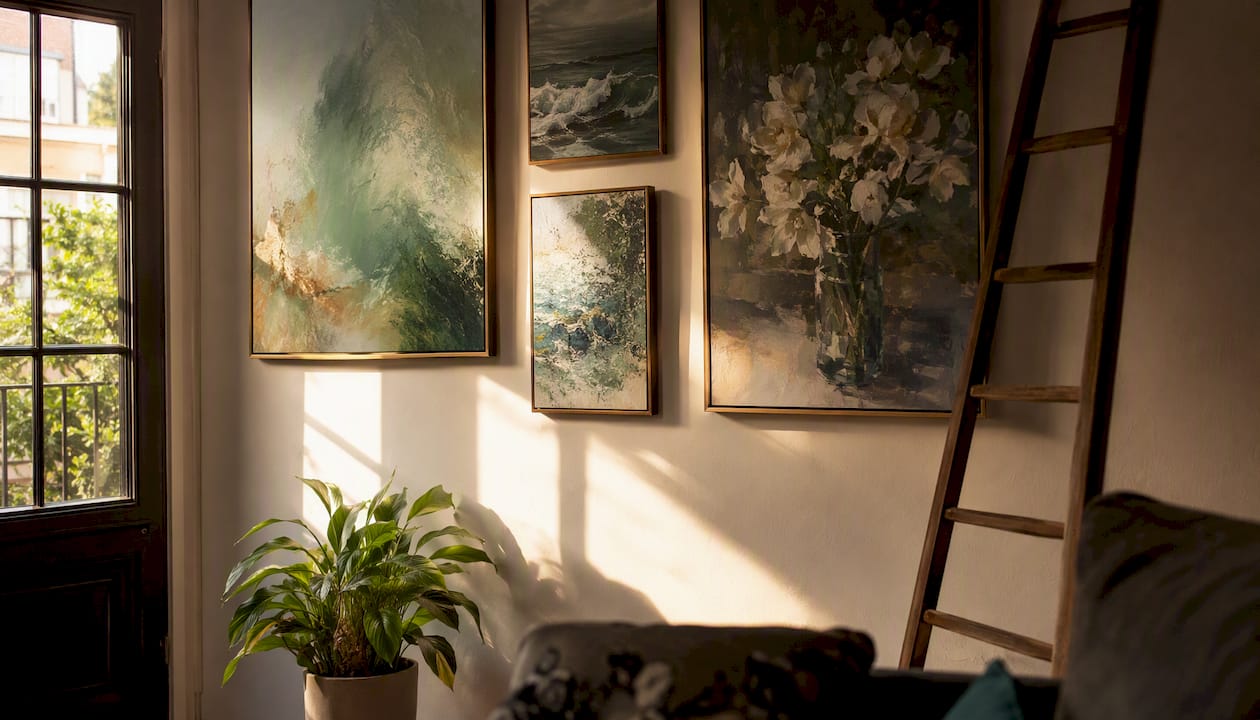
Style by Emily Henderson notes that the “eye-level” rule (center of art at roughly 57–60 inches from the floor) is a useful starting point, but adjusting art height relative to furniture and room proportions often produces better balance. Low ceilings and low-profile furniture call for lower hanging heights.
| Placement | Recommended art width | Vertical gap from furniture |
|---|---|---|
| Above a sofa | 60–75% of sofa width | 6–12 inches above the sofa back |
| Above a console or mantel | 60–75% of console width | 4–6 inches above the surface |
| Tall narrow wall | Up to 80% of wall width | Center vertically in the space |
Before you order, run this checklist:
- Measure the wall width and note the furniture width below it.
- Calculate 60–75% of the sofa or console width to find your target art width.
- Check ceiling height: rooms under 9 feet benefit from vertically oriented pieces.
- Mark the hanging height with painter’s tape before committing.
- Confirm the piece’s shipped dimensions match your measurements, not just the canvas size.
For a detailed step-by-step guide, see how to hang wall art perfectly.
Practical styling approaches that actually work
Pick one dominant strategy per wall. Mixing all three approaches on the same wall creates visual noise. Architectural Digest recommends combining accent walls, floating shelves, and statement artwork to create depth, but the key word is combining, not stacking everything at once.
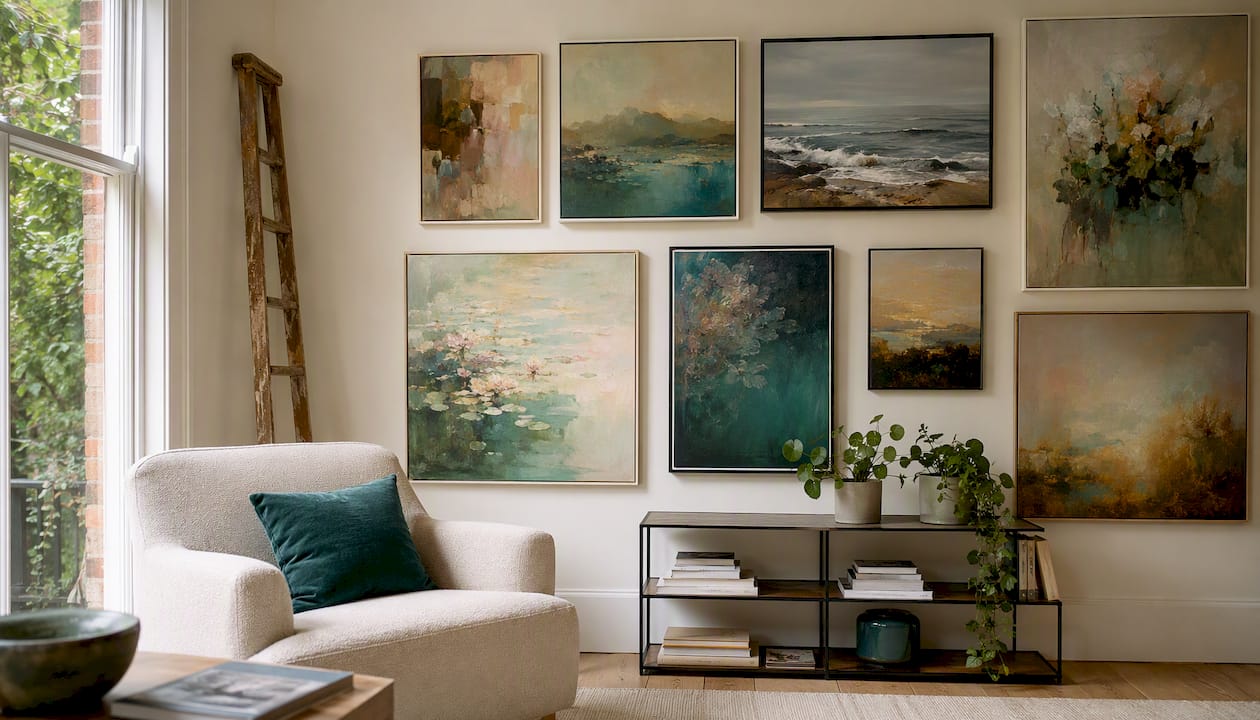
Oversized single piece. The simplest and most impactful option. One large canvas above a sofa reads as intentional and confident.
Gallery wall. Works best when all frames share one finish or one mat color. Lay the arrangement on the floor first. Keep 2–3 inches between frames. Shopping checklist: buy frames in two or three sizes (not five), choose a unifying color thread across all prints, and anchor the arrangement with one larger piece at the center.
Layered ledges. Floating shelves let you mix framed prints, small sculptures, plants, and books. No patching required when you want to change the look. Best for renters and apartment living rooms.
Style variations by aesthetic:
- Modern/minimal: One large abstract canvas, no frame or a thin metal frame, neutral palette.
- Boho/textured: Macramé panel plus a woven basket cluster plus one framed botanical print.
- Classic/luxe: Gilt-framed oil or large canvas print, symmetrical pair of sconces, one statement mirror.
- Eclectic/travel-inspired: Mixed media gallery wall with textiles, photography, and small 3D objects.
Pro Tip: Layer a mirror, a textile panel, and one small sculpture on the same wall for depth without clutter. The mirror reflects light, the textile adds warmth, and the sculpture gives the eye a resting point.
For more interior art display ideas suited to modern living rooms, Emansgallery’s blog covers practical arrangements by room type.
How do materials and finishes affect mood and durability?
Material choice shapes both the atmosphere of a room and how much maintenance a piece requires.
- Textiles (tapestries, macramé, woven panels). Warm, acoustic, and tactile. Best for rooms that feel cold or echo-prone. Humidity and direct sun cause fading and fiber degradation over time; hang away from windows and radiators.
- Metal sculptures. Modern and graphic. Powder-coated finishes resist dust and fingerprints. Avoid humid rooms (bathrooms adjacent to living areas) where bare metal can oxidize.
- Wood panels and carvings. Organic and earthy. Sealed wood resists warping better than raw wood in rooms with variable humidity. Dust with a dry cloth; avoid oil-based cleaners.
- Glass and mirrors. Brightening and space-expanding. Clean with a streak-free glass cleaner. Avoid placing directly opposite a window where glare becomes a problem.
- Canvas and paper prints. Best color fidelity of any format. UV-protective glazing or UV-resistant canvas coating extends life. Keep away from direct sunlight and heat sources.
Matte vs. gloss finishes: Matte surfaces absorb light and suit rooms with strong natural light or bright overhead fixtures. Gloss finishes reflect light and work well in darker rooms, though they can show glare under recessed spotlights. For wall art color coordination with your living room palette, finish choice matters as much as color.
For families and pet households: Wall-mounted metal or sealed wood pieces are more durable than textile hangings at low heights. Floating shelves placed above reach keep fragile pieces safe.
How do you install and light wall hangings safely?
Christie’s recommends double fixings for flat art rather than a single central anchor, and cautions against hanging fragile works above heat sources. Wirecutter confirms that the right hardware plus careful measurement reduces installation errors for nonprofessionals.
Step-by-step for heavier pieces (over 10 lbs):
- Locate wall studs with a stud finder; mark them lightly with a pencil.
- Choose a toggle bolt or rated wall anchor if studs are not where you need them.
- Install D-rings on both sides of the frame’s back panel, not a single wire, for stability.
- Use a level to confirm both anchor points are even before driving screws.
- Hang the piece and test for movement by pressing gently at each corner.
- For very large pieces (over 30 lbs), use two studs or two rated anchors.
Hardware and lighting checklist:
- Picture hooks rated for the piece’s weight (check the packaging).
- Low-profile hangers for frames with a D-ring or keyhole slot.
- A picture light or directional LED sconce aimed at a 30-degree angle to the wall surface.
- A dimmer switch on any accent circuit to adjust mood lighting.
- Hanging prisms or reflective glass accents can amplify natural light near a window wall.
Safety callouts:
- Never hang canvas or paper art directly above a fireplace or radiator. Sustained heat cycles warp canvases and fade paper prints over time.
- In homes with young children, use rated anchors and avoid hanging heavy pieces above seating.
- Check weight ratings on all hardware before installation; the hook’s rating, not the wall material, is the limiting factor.
What do wall hangings cost, and where should you buy them?
Price ranges vary widely by format and source. Here is a practical breakdown for U.S. buyers.
| Tier | Typical price range | What you get |
|---|---|---|
| Budget | Budget price range | Mass-market prints, unframed posters, small mirrors, basic macramé |
| Midrange | Midrange price range | Limited-edition prints, quality framed art, curated mirrors, woven tapestries |
| Premium | Premium price range | Large-format originals, museum-quality canvas prints, statement mirrors |
| Commission | Commission price range | Bespoke original painting sized and styled to your space |
Where to buy:
- Gallery direct (originals and commissions). Emansgallery offers original handmade paintings and museum-quality canvas prints with worldwide shipping. Buying direct gives you access to the artist, accurate provenance, and commission options. Canvas prints such as Fragments of Memory suit midrange budgets with large-scale impact.
- Specialty art print shops. Good for limited-edition prints with documented edition sizes and certificates of authenticity.
- Curated home retailers. Useful for mirrors, ledges, and mass-market prints. West Elm and similar retailers offer wall organization systems (ledges, mirror groupings) as accessible updates without heavy installation.
- Online marketplaces. Wide selection and competitive pricing, but verify seller ratings, return policies, and actual shipped dimensions carefully.
Buying checklist:
- Confirm exact shipped dimensions (not just canvas size).
- Check the return and exchange policy before purchasing.
- Ask about framing options and whether the piece arrives ready to hang.
- For originals, request the artist’s bio and provenance documentation.
- For commissions, confirm lead time in writing before placing a deposit.
Original paintings versus prints: which is right for your space?
Originals deliver a different spatial presence than prints. Brushwork, texture, and the physical surface of a painting interact with room lighting in ways a flat print cannot replicate. That said, prints are an excellent choice for color accuracy, large-scale impact, and budget flexibility.
Decision factors:
- Budget and resale. Originals carry long-term value; prints do not appreciate. If budget is the primary constraint, a museum-quality canvas print at the right scale often outperforms a small original.
- Texture and brushwork. If the room needs tactile depth, an original oil or acrylic painting adds a layer of visual complexity that changes with the light throughout the day.
- Lead time. Prints ship quickly. Commissioned originals typically require 4–12 weeks depending on size and complexity.
- Scale and lighting. Large originals (36 inches and above) interact with directional lighting in ways that justify the premium in high-ceiling rooms.
Emansgallery’s collection includes fluid abstract seascapes like Good Tidings and tonal nocturnal landscapes like Nocturned, both sized for living-room focal walls. The textured fluid art original Mystic Sea demonstrates how layered paint surface changes under different lighting conditions.
Pro Tip: Before commissioning, photograph your wall in both daylight and evening light. Share both images with the artist. Lighting shifts affect color temperature significantly, and a good commission brief accounts for both conditions.
How do you commission or customize a bespoke wall hanging?
Commissioning a bespoke piece removes the guesswork of fitting a ready-made work to a specific wall. The process is straightforward when the brief is clear.
Commissioning checklist:
- Measure first. Provide exact wall dimensions and the dimensions of furniture below the hanging point.
- Define the mood. Share reference images for color palette, atmosphere, and style. Words like “calm,” “energetic,” or “moody” are useful but images are more precise.
- Set a realistic budget. Commission prices reflect size, medium, and artist demand. Agree on a price and deposit structure in writing before work begins.
- Confirm timeline. Most original commissions take 4–12 weeks. Factor in shipping and any framing lead time.
- Discuss framing and installation. Decide whether the artist or a local framer handles framing. Confirm the piece arrives with hanging hardware or D-rings installed.
- Clarify delivery and insurance. For high-value originals, confirm whether the shipping includes insurance and what the damage policy covers.
For customizing an existing print rather than commissioning from scratch, many galleries offer size and framing options at the point of purchase. Specifying a custom size, a particular frame finish, or a canvas wrap depth are all standard requests that do not require a full commission process.
A note on how we approach living-room art
Living rooms are the most demanding spaces to hang art well. The scale is large, the lighting is variable, and the piece has to hold up to daily scrutiny from multiple angles and distances. The work that performs best in these rooms tends to share a few qualities: strong tonal contrast, a surface that responds to light, and a scale that commands the wall rather than apologizing for it.
At Emansgallery, the selection process starts with those criteria. Eman Khalifa’s paintings in fluid abstraction, seascape, and tonal landscape are developed specifically with large-wall presence in mind. The brushwork and layered surfaces are built to read differently at 10 feet than at 3 feet, which is exactly what a living-room focal piece needs to do.
If you are deciding between an original and a print, the honest answer is: both can work. The right choice depends on your wall, your light, and your budget. Browse the curated wall art collection or request a commission brief directly through the gallery.
Eman’s Gallery originals and prints for living-room walls

Emansgallery offers original handmade paintings, museum-quality canvas prints, and bespoke commissions sized for living-room focal walls. Originals by Eman Khalifa ship worldwide from fulfillment centers in the U.S., UK, Canada, Australia, and across Europe. Canvas prints arrive ready to hang. Commission lead times run 4–12 weeks depending on size and complexity, with framing options available at checkout.
For a high-impact focal wall, the fluid abstract original Good Tidings and the large-format canvas print Private Eye are strong starting points. Browse the full collection at Emansgallery or contact the gallery directly to discuss a commission brief, sizing options, and return policy details.
Sources
FAQ
What size wall hanging works best above a sofa?
Aim for a piece sized proportionally to the sofa’s width, hung with moderate clearance above the sofa back.
How high should you hang art on a living-room wall?
The standard starting point is a center height of 57–60 inches from the floor. Adjust lower when ceilings are under 9 feet or furniture is low-profile, so the art relates visually to the pieces below it.
What is the difference between a canvas print and an original painting for a living room?
An original painting has physical texture and brushwork that responds to light; a canvas print delivers accurate color and large scale at a lower price. Both work well as focal pieces; the choice depends on budget and whether tactile surface matters to you.
Can you mix different types of wall hangings in one living room?
Yes. A common approach is one dominant piece (large canvas or original) on the main wall, a textile or mirror on a secondary wall, and a ledge arrangement on a third. Keep each wall to one strategy to avoid visual competition.
How do you commission a custom wall hanging for a specific space?
Provide the artist with exact wall dimensions, furniture measurements, reference images for mood and palette, and a confirmed budget. Most original commissions take 4–12 weeks. Emansgallery accepts commissions with framing and worldwide shipping included.
Stay Connected
- ✨ Explore Eman Khalifa's original art, fine art prints and art-inspired merchandise.
- Follow Eman Khalifa's art journey on: Instagram @emans_gallery and Facebook
- Watch Eman Khalifa creating live art on: YouTube @emans_gallery
